While the industry is still arguing about which chatbot sounds the smartest, Google has quietly shifted the center of gravity. Not toward a new app. Not toward a flashy interface. Toward something far more ordinary — and therefore far more powerful.
The browser.
By integrating Gemini directly into Google Chrome, Google isn’t trying to answer questions better. It’s trying to intervene before questions are fully formed, while work is already happening, and sometimes instead of the user altogether.
Chatbots Impress, Browsers Shape Behavior
A chatbot is intentional.
You open it to get an answer, then you leave.
A browser is different.
It’s where work already lives.
Research, reading, comparison, purchases, forms, planning. Eight hours a day for millions of people. Chrome doesn’t need to win adoption. It already has it.
That’s exactly why Gemini’s integration isn’t a feature update. It turns a passive tool into an active layer of the web.
The Side Panel Isn’t Flashy — It’s Decisive
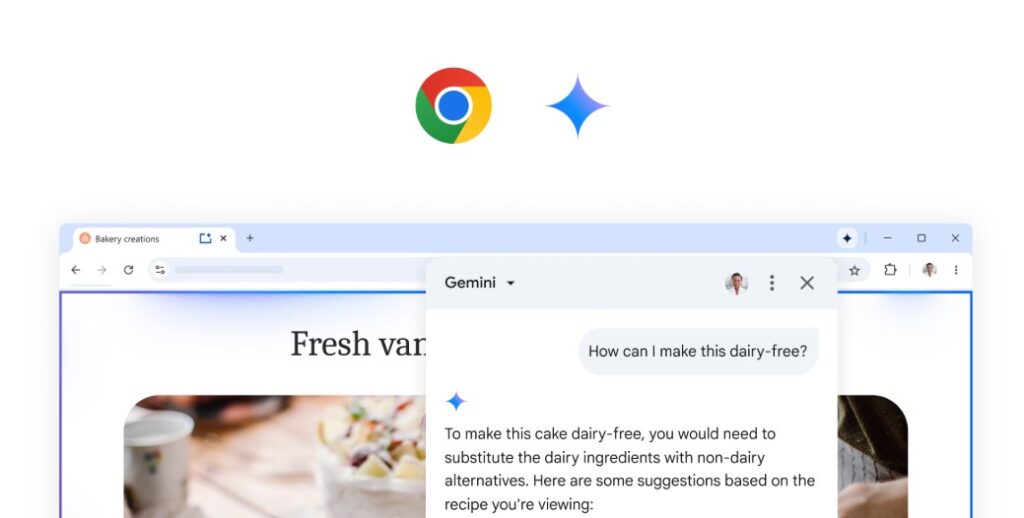
The new Gemini side panel doesn’t try to impress. It doesn’t even ask for attention. It simply stays there, next to the page you’re working on.
That’s where the real shift happens.
Summarizing reviews without leaving a comparison page. Lining up offers without opening ten tabs. Checking a calendar while reading an email. None of this is revolutionary on its own. Together, it changes how attention moves.
The browser no longer just displays information. It coordinates action.
Auto Browse: A Quiet but Structural Agent
Auto browse is presented as an “agentic” leap. The term is fashionable, but the reality is more interesting than the label.
The agent doesn’t try to do everything. It takes over what humans do poorly: repetitive navigation, comparisons, data collection, date matching, document gathering. Then it stops. Always before sensitive actions.
Payments. Bookings. Publishing. Control stays human.
That choice matters. Google isn’t promising autonomy. It’s promising the removal of low-value effort. Less spectacular, but far more scalable.
Google’s Real Advantage Isn’t the Model
Gemini is strong. That’s not the point.
The real advantage is habit.
Chrome is already installed. Already used. Already central. The user doesn’t need to learn anything new or change behavior. AI arrives inside an existing gesture.
That’s why comparisons with standalone assistants miss the mark. Others try to pull users into a new space. Google upgrades the space they never left.
Changing the Browser Means Steering Decisions
A search engine ranks.
A chatbot answers.
A browser equipped with AI steers.
When Gemini summarizes reviews, surfaces options, cross-references Gmail, Calendar, or Flights, it’s not just helping. It’s shaping the decision path.
Fewer direct clicks. Less exhaustive exploration. More delegated judgment.
The web remains open. But access becomes mediated. Not closed — filtered. And that’s a different kind of power.
A Riskier Strategy Than It Looks
Auto browse relies on reading interfaces designed for humans. That’s fragile. Unstable. Vulnerable to UI changes.
Google knows this.
But perfection isn’t the goal. Centrality is. If Chrome becomes the place where work is organized, imperfections will be tolerated, then smoothed out.
This is an infrastructure play, not a demo.
What Google Is Really Announcing
With Gemini in Chrome, Google isn’t selling a smarter AI. It’s installing a persistent presence inside the flow of work.
The next step already hinted at — opt-in contextual memory — follows the same logic. An AI that remembers, anticipates, and suggests. Not because it’s brilliant, but because it’s always there.
Google isn’t building an assistant.
It’s redefining what a browser does.
And in a web already drowning in information, controlling the flow often matters more than producing the best answer.