
A less expensive apartment can make Edmonton appealing. But before deciding whether a salary will cover your needs, look at what remains after housing, transportation, groceries, and expenses that don’t arrive every month.
To estimate the cost of living in Edmonton, start with a home you could realistically rent, then build a budget around your household and travel needs. Someone living alone, two roommates, and a family won’t allocate their income the same way.
If you’re comparing Alberta’s two largest cities, our guide to the cost of living in Calgary explores the other option. Here, we’ll focus on how sharing expenses changes an Edmonton budget.
How Much Does an Apartment Cost in Edmonton?
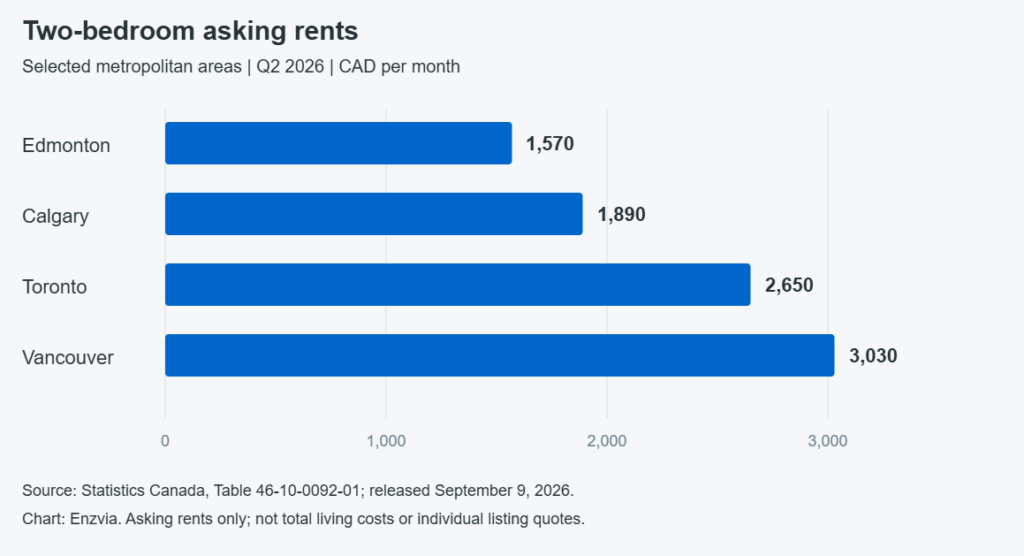
Statistics Canada puts the average asking rent for a two-bedroom apartment in the Edmonton metropolitan area at CAD 1,570 per month in the second quarter of 2026.
For the same measure and period, Calgary was CAD 1,890, Toronto CAD 2,650, and Vancouver CAD 3,030. These figures come from Statistics Canada’s official rental comparison.
They are metropolitan-area averages for advertised rents. They don’t represent every neighbourhood or a survey of listings available today.
| Metropolitan area | Monthly asking rent |
|---|---|
| Edmonton | CAD 1,570 |
| Calgary | CAD 1,890 |
| Toronto | CAD 2,650 |
| Vancouver | CAD 3,030 |
Two-bedroom apartments, second quarter of 2026. Source: Statistics Canada. Chart: Enzvia.
The difference between Edmonton and Calgary is CAD 320 per month, or CAD 3,840 over twelve months. That’s a reference point for comparing markets, not guaranteed savings on your next home.
Living Alone or Sharing: Two Different Budgets
The same apartment can place a very different burden on your finances depending on whether one person pays everything or two adults split the expenses.
The following tables present two illustrative Enzvia scenarios, not measured averages of Edmonton residents’ spending.
We use the CAD 1,570 two-bedroom rental benchmark and the CAD 102 standard adult monthly ETS fare cap. All other amounts are chosen planning allowances that should be replaced with your own expenses and quotes.
| Monthly expense | One person covering the home |
|---|---|
| Reference rent, two-bedroom apartment | CAD 1,570 |
| Utilities, chosen allowance | CAD 180 |
| Groceries, chosen allowance | CAD 400 |
| Internet and phone, chosen allowance | CAD 95 |
| Tenant insurance, chosen allowance | CAD 30 |
| ETS transportation, adult monthly cap | CAD 102 |
| Personal spending and leisure | CAD 180 |
| Savings and unexpected expenses, chosen target | CAD 250 |
| Illustrative monthly total | CAD 2,807 |
This scenario doesn’t suggest that someone living alone needs a two-bedroom apartment. It shows the cost of covering the entire home used for this comparison.
Now consider two adults splitting the same home equally:
| Monthly expense | Total for two adults |
|---|---|
| Reference rent | CAD 1,570 |
| Utilities, chosen allowance | CAD 200 |
| Groceries, chosen allowance | CAD 800 |
| Internet and phones, chosen allowance | CAD 130 |
| Tenant insurance, chosen allowance | CAD 40 |
| ETS transportation, two adult monthly caps | CAD 204 |
| Personal spending and leisure | CAD 320 |
| Savings and unexpected expenses, chosen target | CAD 400 |
| Illustrative household total | CAD 3,664 |
| Per adult, split equally | CAD 1,832 |
These examples exclude children, debt repayments, tuition, travel, and significant health expenses. They aren’t minimum salary recommendations or estimates of the income everyone needs to live comfortably.
Can You Use Transit Instead of Owning a Car?
The City of Edmonton lists a CAD 3 adult fare for 90 minutes when using an eligible Arc payment method, with a CAD 102 monthly cap. The cash fare is CAD 3.75. Conditions and fare categories appear on the official ETS fares page.
The monthly cap isn’t an amount every rider automatically spends. Your actual cost depends on your journeys and applicable fare.
Before choosing an address, check:
- Your commute at the times you actually travel.
- The return journey after a late shift.
- Access to groceries and regular appointments.
- Trips involving another regional transit service.
Compare housing and transportation together, rather than comparing two rents in isolation.
If you keep a car, replace the ETS allowance with your own calculation: financing or lease payments, insurance, fuel, parking, maintenance, and periodic expenses. Keeping a car while using transit can mean paying for both.
Which Utilities Should You Add to Rent?
Before signing, request a written list of what’s included: heat, water, electricity, parking, laundry, and internet access.
A CAD 1,500 apartment with several services included isn’t directly comparable to another CAD 1,500 apartment that charges for them separately.
Where available, ask for representative bills or consumption history. Check whether services are individually metered and which accounts you’ll need to open.
If you’re sharing, agree on the split in advance. Dividing everything equally can be straightforward, but it should reflect your agreement. Different bedroom sizes, parking access, or particular usage arrangements may justify another approach.
Everyone should understand their share before committing.
Build Your Grocery Allowance Around Your Habits
Our CAD 400 allowance per adult is simply an input for the example. It isn’t an official average or a target suitable for everyone.
To build your own estimate, plan a realistic week of meals and check the basket’s cost at a store you could conveniently use.
Keep groceries separate from restaurants, coffee shops, and delivery orders. That makes it easier to distinguish meals prepared at home from spending associated with going out.
Include cleaning and personal-care products if you buy them with groceries, or give them a separate category. The goal is to avoid leaving them out altogether.
Before moving, also review your recurring subscriptions and services you no longer use. They’ll continue affecting your budget even if your rent decreases.
What Income Do You Need to Live in Edmonton?
Start with your available take-home income after applicable deductions, then compare it with your complete budget.
In our first scenario, someone with CAD 3,500 in monthly take-home income would have CAD 693 remaining after the included categories:
CAD 3,500 − CAD 2,807 = CAD 693.
That balance still needs to cover expenses excluded from the example or underestimated in the allowances. It isn’t automatically discretionary spending money.
If your income varies, run the calculation for a weaker month too. A budget that consistently depends on overtime or another contract deserves a closer look.
Avoid converting this example directly into a universal gross salary requirement. Payroll deductions and household circumstances change the result.
Keep Moving Costs Separate
Your regular monthly budget doesn’t describe the cost of getting established.
Add moving expenses, essential purchases, any temporary accommodation, and service setup fees. Record the amounts requested when signing the lease and when each payment is due.
A simple list works: confirmed amount, amount to verify, and payment date.
If you’re planning to share a home, discuss what would happen if an unexpected shared expense arose. An arrangement that looks affordable on paper also needs to work in everyday life.
Your Budget Depends on How You Organize Your Life
In the comparable rental data, Edmonton’s asking rent is lower than that of several other large metropolitan areas. Your personal budget will then depend on the home you choose, how you share expenses, and where you need to travel.
Use official figures as reference points, then replace the assumptions with your actual amounts. That step turns a city comparison into a useful decision.
For a different housing market, explore our guide to the cost of living in Vancouver.
Planning a move with a partner or roommate? Share this guide so you can build the budget together before choosing a home.