
A higher-paying job in Toronto may look more attractive than an offer in London. But once rent, commuting, and childcare enter the picture, the difference can shrink. When choosing where to live in Ontario, the advertised salary tells only part of the story.
There isn’t one income that allows every household to live comfortably across the province. Your budget depends on the home you need, how many people earn an income, and whether everyday life requires a car.
A useful comparison starts with comparable expenses. This guide uses asking rents for two-bedroom apartments, then explains how to adapt that starting point to your household.
Our cost of living in Canada by province and city guide provides a national overview. Here, we take a closer look at five Ontario destinations.
Housing: An $800 Monthly Difference
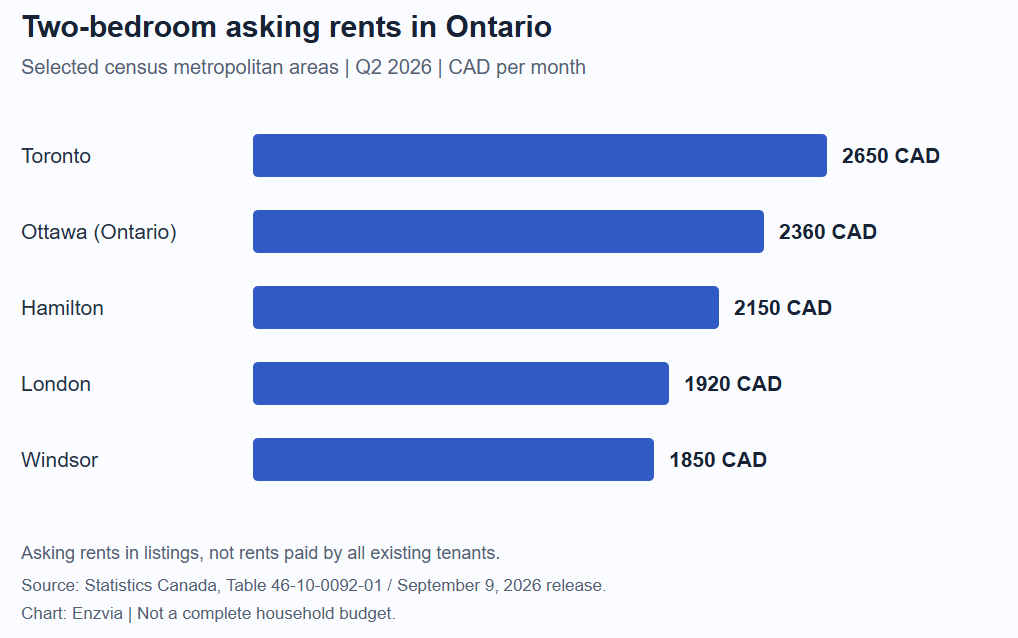
In the second quarter of 2026, Statistics Canada reported these average monthly asking rents for two-bedroom apartments in the selected metropolitan areas:
- Toronto: CA$2,650.
- Ottawa–Gatineau, Ontario part: CA$2,360.
- Hamilton: CA$2,150.
- London: CA$1,920.
- Windsor: CA$1,850.
These figures come from listings on major rental platforms. They aren’t the average rents paid by all existing tenants or guaranteed prices for individual apartments. The areas are census metropolitan areas, rather than municipal boundaries alone. Statistics Canada’s official comparison.
The difference between Toronto and Windsor is CA$800 per month, or CA$9,600 over a year. That’s substantial, but it still needs to be weighed against other expenses.
What Income Would Support Those Rents?
One way to build a reference point is to choose a maximum share of gross household income for rent.
The following calculation uses 30% as a planning assumption. It isn’t an estimate of the income required to live comfortably. It excludes additional housing costs and all other household expenses.
The formula is:
Monthly rent × 12 ÷ 0.30 = corresponding annual gross household income.
Using the asking rents above gives:
- Toronto: CA$106,000 in annual gross household income.
- Ottawa, Ontario part: CA$94,400.
- Hamilton: CA$86,000.
- London: CA$76,800.
- Windsor: CA$74,000.
These amounts describe a relationship between rent and income. Someone paying less rent would get a different result. A household carrying substantial debt may need more room in its budget.
Don’t read “CA$106,000 in Toronto” as an official income requirement for everyone living there. It’s the result of an explicit assumption applied to one apartment type.
Living Wage and Living Comfortably Aren’t the Same Measure
The Ontario Living Wage Network publishes another reference point: the hourly pay needed to cover a basket of basic expenses and participate in community life.
Its November 2026 calculations include CA$27.60 per hour in the Greater Toronto Area and CA$24.10 in Ottawa.
Those rates need context. The methodology combines several household configurations into a weighted average. They aren’t individual household budgets that can automatically be applied to a single adult or a family.
The calculation uses a 35-hour workweek, accounts for taxes and government transfers, and includes a contingency allowance. Ontario Living Wage Network’s 2026 methodology.
To define your own financial comfort, add specific goals: debt repayment, savings, retirement contributions, travel, or replacing a vehicle. Two households paying the same rent can reasonably target different incomes.
Toronto: Consider Housing and Commuting Together
Toronto has the highest asking rent in this five-city comparison, making the neighborhood and commute particularly important.
Before comparing two apartments, record:
- Rent and included utilities.
- Transportation costs.
- Any parking charges.
- Travel time during your actual working hours.
- Whether living without a car is realistic.
A more expensive, well-located apartment might reduce some transportation expenses. A cheaper home farther away could add regional transit fares, parking, or car ownership to your budget.
Compare addresses and actual journeys, rather than city names alone.
Ottawa: Look at What Remains After Housing
The reference asking rent is CA$290 per month below Toronto’s, a difference of CA$3,480 annually.
That becomes meaningful when you connect it to your own situation: workplace location, transportation needs, and household size.
For a couple, consider whether both workplaces are accessible from the proposed home. If you live alone, compare a room in a shared home or a one-bedroom apartment, too. The two-bedroom apartment used here may not be the right fit.
Hamilton: Include the Cost of Working Elsewhere
Hamilton’s reference asking rent is CA$500 per month below Toronto’s.
If your job remains in the Toronto area, calculate the full commute: tickets or passes, travel to the station, parking, and any additional connections.
An employer requiring more office attendance can change the financial appeal of a move.
Before signing a lease, build two budgets: one reflecting your current work arrangement and another with more days on-site. You’ll see whether the savings hold up.
London and Windsor: Keep the Housing Savings Intact
London and Windsor have the lowest asking rents among the five metropolitan areas compared.
That creates an opportunity to reduce housing expenses, but it doesn’t establish that every other cost will be lower.
Check:
- Take-home income from the job available to you.
- Travel between home, work, and school.
- Whether you would need a second car.
- Costs attached to the specific property.
- Moving and setup expenses.
Lower rent improves your budget only to the extent that new expenses don’t absorb the difference.
Adapt the Budget to Your Household
If You Live Alone
Housing takes a larger share of the budget when one person pays for it. Start by choosing a realistic arrangement: shared housing, a studio, or a separate apartment.
Then work with your actual take-home income. Don’t treat a household income figure as an individual salary requirement.
If You’re a Couple Without Children
You can share some expenses, but not everything divides neatly in half. Two workplaces can mean two commutes or two vehicles.
Calculate each person’s take-home pay before adding the amounts together. Then separate shared expenses from individual commitments.
To find room in your existing budget, review automatic payments as well. Our guide to identifying and managing unwanted subscriptions provides a practical starting point.
If You Have Two Children
Your children’s ages change the calculation. A household with one child in daycare and another in school has different needs from a family with two teenagers.
Get actual quotes for childcare, before- and after-school care, and school-break activities. Check availability before building a budget around a particular rate.
A two-bedroom apartment may not meet your family’s needs. Use the comparison as a starting point, then price the housing that fits your situation.
Build a Monthly Budget Without Inventing a Universal Number
For each location, work through the same expense categories:
- Housing: rent, utilities, insurance, and parking.
- Food: your household’s recent spending, adjusted where necessary.
- Transportation: transit, vehicle payments, insurance, fuel, and maintenance.
- Children: childcare, school expenses, activities, and school breaks.
- Health and communications: uncovered health expenses, phone, and internet.
- Commitments: debts and other required payments.
- Goals: savings and a financial buffer.
Compare the total with your household’s take-home income. Add government benefits only after confirming eligibility and the amount you can expect.
Our article on measures proposed in Canada’s 2026 federal budget offers context. A proposed measure shouldn’t become guaranteed income in your calculations.
The right location isn’t necessarily the one with the lowest rent. It’s the place where your income, housing, and daily routine work together, with a financial margin you understand.
Turn Your Budget Into a Decision Tool
With Enzvia Signals, discover practical spending tips, useful apps, and free tools that make everyday life easier.
Join curious readers and get fresh ideas to help you spend smarter. Subscribe below.