
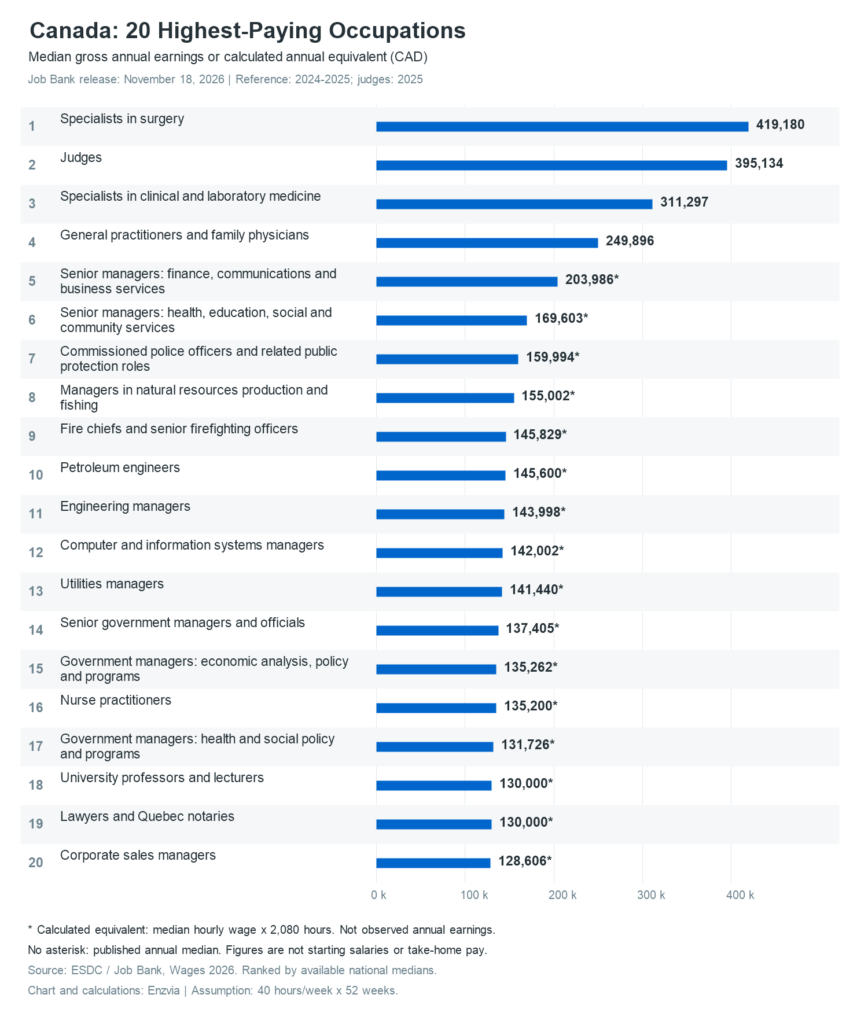
Surgical specialists lead the ranking, with median annual earnings of CAD 419,180 in Job Bank’s wage data. Judges and specialists in clinical and laboratory medicine follow. Healthcare dominates the top positions, but senior management, engineering, and information systems also feature prominently.
Choosing a career takes more than finding the largest number, though. You need to understand what that figure measures, which qualifications the occupation requires, and where that pay might fit into a longer career.
Location matters, too. Before comparing offers, our guide to the cost of living in Ontario explains how housing and other expenses differ between several cities.
Below are the occupations with the highest available national medians in Job Bank’s wage file released on November 18, 2026. The ranking distinguishes published annual earnings from annual equivalents calculated using hourly wages.
What Are the Highest-Paying Jobs in Canada?
This ranking uses available national medians from the official Job Bank wage dataset.
For occupations reported hourly, we calculated an annual equivalent using 2,080 hours: 40 hours a week for 52 weeks. These figures have an asterisk.
| Occupation | Annual median or calculated annual equivalent |
|---|---|
| Specialists in surgery | CAD 419,180 |
| Judges | CAD 395,134 |
| Specialists in clinical and laboratory medicine | CAD 311,297 |
| General practitioners and family physicians | CAD 249,896 |
|
Senior managers: financial, communications, and other business services |
CAD 203,986* |
|
Senior managers: health, education, social and community services, and membership organizations |
CAD 169,603* |
|
Commissioned police officers and related public protection occupations |
CAD 159,994* |
| Managers in natural resources production and fishing | CAD 155,002* |
| Fire chiefs and senior firefighting officers | CAD 145,829* |
| Petroleum engineers | CAD 145,600* |
| Engineering managers | CAD 143,998* |
| Computer and information systems managers | CAD 142,002* |
| Utilities managers | CAD 141,440* |
| Senior government managers and officials | CAD 137,405* |
|
Government managers: economic analysis, policy development, and program administration |
CAD 135,262* |
| Nurse practitioners | CAD 135,200* |
|
Government managers: health and social policy development and program administration |
CAD 131,726* |
| University professors and lecturers | CAD 130,000* |
| Lawyers and Quebec notaries | CAD 130,000* |
| Corporate sales managers | CAD 128,606* |
How to read this table:
Figures marked with an asterisk (*) are calculated annual
equivalents: median hourly wage multiplied by 2,080 hours
(40 hours per week for 52 weeks). They are not observed
annual earnings. Unmarked figures are annual medians
published directly. All amounts are gross, in Canadian
dollars, and rounded to the nearest dollar. These are
not starting salaries or guaranteed take-home earnings.
Source: ESDC / Job Bank, Wages 2026,
released November 18, 2026. Reference period: 2024-2025,
except judges: 2025. Ranked by available national medians.
University professors and lecturers and lawyers and
Quebec notaries are tied at CAD 130,000.
Annualization calculations: Enzvia.
Figures marked with an asterisk are calculated annual equivalents, not observed annual earnings. Unmarked figures are annual medians published directly. All amounts are gross, rounded to the nearest dollar. The reference period is 2024–2025, except for judges, whose figures cover 2025. The two occupations at CAD 130,000 are tied.
What These Salary Figures Actually Tell You
Original Enzvia Chart
The median divides earnings into two halves: half fall below it, and half above it. It is neither a starting salary nor the maximum someone could earn.
A student considering medicine shouldn’t read CAD 419,180 as the income available immediately after their initial studies. Likewise, the figure for information systems managers doesn’t represent the pay for a first job in technology.
Annual equivalents need some care as well. Petroleum engineers have a national median hourly wage of CAD 70 in the file. Multiplying that rate by 2,080 produces CAD 145,600. Change the working hours, and the result changes.
That calculation makes the ranking easier to compare. It doesn’t establish the actual schedule, weeks worked, or contract terms for an individual worker.
Physician earnings also follow a particular methodology. Job Bank’s figures incorporate an adjustment for overhead expenses. They shouldn’t be treated as gross business revenue from which the same overhead must automatically be deducted again.
Why Healthcare and Management Lead the Ranking
Two broad career paths stand out.
One involves specialized, regulated qualifications, particularly in medicine. The other leads to senior responsibilities through professional progression.
Those paths require different planning. Someone with an established technology career might investigate the skills needed to manage a team or department. Someone considering surgery needs to evaluate a much longer medical training pathway.
The National Occupational Classification provides useful starting points:
- Medical specialists: medical education, specialty training, and authorization to practise.
- Judges: generally extensive legal experience before appointment.
- Engineering managers: substantial engineering experience, including supervisory responsibilities.
- Nurse practitioners: advanced nursing education and clinical experience.
- Senior managers: progression into management responsibilities within their field.
Exact requirements depend on the position and, for regulated occupations, the province or territory. These summaries help identify what to investigate. They don’t replace an institution’s admission requirements or a regulator’s licensing rules.
Which Jobs Pay Well Without Going Into Medicine?
Several occupations in the ranking sit outside medicine: financial leadership, information systems management, engineering, natural resources, utilities, and corporate sales.
The useful distinction is between the field you enter and the position you work toward.
Computer and information systems managers, for example, have a national median hourly wage of CAD 68.27, equivalent to approximately CAD 142,002 under our annualization assumption. That figure covers a management occupation. It doesn’t establish the same pay for every developer, technician, or systems administrator.
If you already work in that field, a more practical career search would examine:
- The responsibilities attached to available management positions.
- The technical and leadership experience employers request.
- The size of the teams and budgets involved.
- The guaranteed pay and employment conditions being offered.
Apply the same approach to sales positions. Check the fixed and variable components of compensation before building a household budget around potential earnings.
Does the Province Change the Comparison?
Yes. A national figure provides background, but a local offer deserves a local comparison.
For computer and information systems managers, the 2026 file reports median hourly wages of CAD 69.23 in Ontario and CAD 71.11 in British Columbia, using 2024–2025 data.
That difference alone doesn’t establish which province would leave you financially better off. Housing, transportation, and household expenses also belong in the calculation.
If an opportunity would take you to Alberta, our guide to the cost of living in Calgary shows how transportation expenses can offset a lower rent.
Compare an actual offer with a realistic way of living. A provincial median doesn’t guarantee that an employer will offer you that amount.
Can You Earn More Than CAD 100,000 Without a University Degree?
That question deserves a separate comparison. This table doesn’t rank occupations by accessibility without a degree.
Not needing a university degree doesn’t necessarily mean entering a field without training. Depending on the occupation, apprenticeships, certifications, safety requirements, and professional experience may matter.
Start with the position you could realistically obtain after completing the relevant training. Then investigate the steps needed to progress.
Avoid comparing a beginner’s wage in one occupation with the median for senior managers in another. Those figures describe very different stages of a career.
How to Use This Ranking to Plan Your Next Move
Choose three occupations that fit your circumstances, then build a short profile for each:
- Your starting point: education, experience, and transferable skills.
- Entry requirements: training, licensing, or credential recognition.
- The cost of the pathway: tuition, equipment, travel, and any reduction in earnings while studying.
- Local opportunities: available positions and the qualifications employers request.
- Pay at your likely entry point: separate from earnings later in the career.
This turns a salary ranking into a more useful decision. High earnings can be attractive, but the time and expense required to reach them matter as well.
When comparing offers, use expected take-home income and a complete household budget. Include expenses the new position would introduce, such as relocation, commuting, childcare, or equipment.
Our guide to budgeting for life in Vancouver offers a practical way to separate shared housing costs, personal spending, and commonly overlooked expenses.
Use the Numbers to Narrow Your Search
Medical occupations occupy the highest positions, but management, engineering, and technology also offer substantial median earnings.
Use the figures to identify a possibility, then investigate the path between your current situation and that occupation. Check the precise role, location, qualifications, and employment conditions before treating a headline amount as your expected income.
A median wage helps you ask better questions. A concrete offer and a personal budget help you make the decision.
Know someone considering a career change or choosing what to study? Share this ranking to help them compare the earnings with the pathway required.