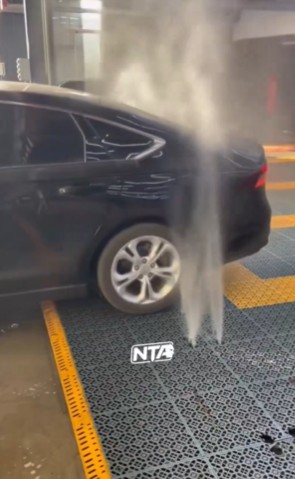
China isn’t upgrading the car wash.
It’s replacing it.
Some new automated stations clean a car in seconds by blasting it with dense, vertical jets of water, like an artificial storm.Not about perfection.
About speed, scale, and urban reality. pic.twitter.com/5IXIUEaHZk— Enzvia (@enzvia) January 23, 2026
In China, some automated car wash stations no longer try to replicate the brush-and-roller model common in the West. Instead, they embrace a different idea altogether: ultra-dense, vertical water projection that engulfs the vehicle like an artificial downpour. In seconds, the car disappears behind a curtain of water, foam, and mist.
This is not a visual gimmick. It is a direct response to two very Chinese constraints: time scarcity and urban density.
Why China is pushing ultra-fast car washing
In major Chinese cities, car washing is treated as a throughput problem, not an experience. Stations are designed to process large volumes of vehicles in limited space, with minimal human intervention.
These systems rely on three core principles:
-
vertically oriented high-pressure jets to cover maximum surface area instantly
-
near-total automation, without complex moving brushes
-
extremely short wash cycles, sometimes under one minute
The goal is not perfection. It is speed, consistency, and scale. Think of it as the automotive equivalent of cashierless payment: fewer steps, less waiting, no friction.
A break from the Western car wash model
In Europe and North America, automated car washing is still dominated by two approaches: roller tunnels and manual high-pressure bays. Both prioritize gradual cleaning, precision, and, to some extent, care for the vehicle’s finish.
The Chinese model flips that logic. It accepts a degree of controlled aggressiveness: more water, more pressure, far less time. Visually, it can feel excessive. Functionally, it fits daily urban use, especially for modern vehicles engineered to withstand this kind of treatment.
Genuine innovation or controlled spectacle
Skepticism is warranted. These videos typically show ideal conditions: relatively clean cars, short cycles, and carefully framed angles. Open questions remain:
-
long-term impact on paint and clear coat
-
real water consumption per cycle
-
effectiveness on heavy or caked-on dirt
Still, one point is hard to ignore. China is not trying to optimize the traditional car wash. It is redefining it around its own constraints. Faster. More dramatic. Less sentimental.
As is often the case, what starts as a local curiosity tends to travel. Not immediately to neighborhood stations in Europe or North America, but into automated parking facilities, fleet services, and high-throughput environments. In those contexts, this artificial “rainstorm” already makes a certain kind of sense.