Amazon is not launching an AI that writes films, replaces directors, or generates finished TV shows at the push of a button.
AI Studio is something far more specific and far more strategic: an internal production system designed to compress costs and timelines in pre-production and production, not to automate creativity.
Based on what Amazon has disclosed, AI Studio focuses on:
-
AI-assisted storyboarding and previs
-
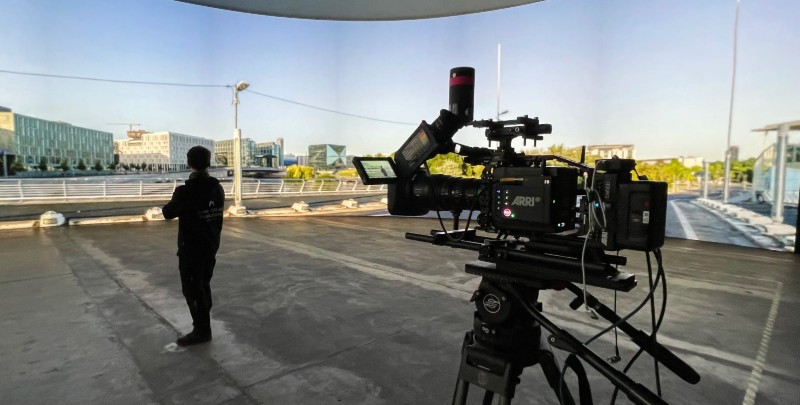
Virtual and synthetic environments replacing physical sets
-
Rapid iteration of test scenes
-
Early visualization to validate creative and budget decisions
This places AI Studio firmly in the category of industrial virtual production, not generative filmmaking.
That distinction matters, because it explains both the ambition and the limits of the project.
Where the Real Cost Savings Actually Come From
Film and TV budgets do not spiral primarily because of actors or scripts. They spiral because of everything that happens around them.
The most expensive friction points tend to be:
-
Location scouting and logistics
-
Physical set construction and teardown
-
Weather delays and reshoots
-
Late-stage creative changes discovered too late
Across mid-budget films and premium series, physical production infrastructure can account for 20% to 35% of total production costs, sometimes more for location-heavy shoots.
AI Studio targets exactly this layer.
If a production can validate locations, lighting, camera movement, and scene blocking virtually before committing real resources, the savings compound quickly. Even modest efficiency gains become meaningful when applied across dozens or hundreds of productions.
Amazon does not need breakthroughs. It needs repeatable marginal improvements at scale.
This Is About Scale Economics, Not Artistic Innovation
Amazon’s competitive advantage is not better taste or bolder storytelling. It is operational scale.
AI Studio follows the same logic Amazon applies elsewhere:
-
logistics optimization in retail
-
infrastructure efficiency in cloud computing
-
margin compression through process standardization
In isolation, AI-assisted previs is not revolutionary. At Amazon’s volume, it becomes structural.
The goal is not to make better individual films. It is to make the entire production pipeline faster, cheaper, and more predictable.
Why Traditional Studios Are More Exposed Than Indie Creators
Independent filmmakers already operate under extreme constraints. They shoot lean, avoid unnecessary sets, and accept creative trade-offs early.
Traditional studios, by contrast, still rely on:
-
expensive proof-of-concept phases
-
conservative greenlighting processes
-
late discovery of production risks
AI-driven visualization allows Amazon to test more ideas earlier, kill weaker projects faster, and reallocate budgets with less sunk cost.
That changes portfolio math.
The studio that can afford to fail cheaply can afford to experiment more often. Over time, that advantage compounds.
The Uncomfortable Implication Most Coverage Ignores
Lower production costs almost always lead to higher content volume.
But audience attention does not scale.
If AI Studio succeeds, the likely outcomes are:
-
more shows produced
-
shorter average lifespan for mid-performing content
-
increased pressure on marketing, discovery, and distribution
Cost efficiency does not guarantee better cultural outcomes. Historically, it often leads to content inflation, where supply outpaces meaningful demand.
Amazon is structurally positioned to absorb that imbalance. Many competitors are not.
What AI Studio Is Not, At Least for Now
Clarity matters.
AI Studio is not:
-
fully AI-written scripts
-
synthetic lead actors replacing humans
-
autonomous film or TV generation
Those ideas generate clicks. They do not reflect the actual system being built.
What Amazon is doing is quieter and more consequential. It is treating film production as a repeatable industrial process, closer to infrastructure than to artisanal creation.
Amazon has already transformed retail, logistics, and cloud computing by applying that mindset.
AI Studio suggests the same approach is now being applied to entertainment.
Not to replace creators.
But to reshape the conditions under which creation happens.