
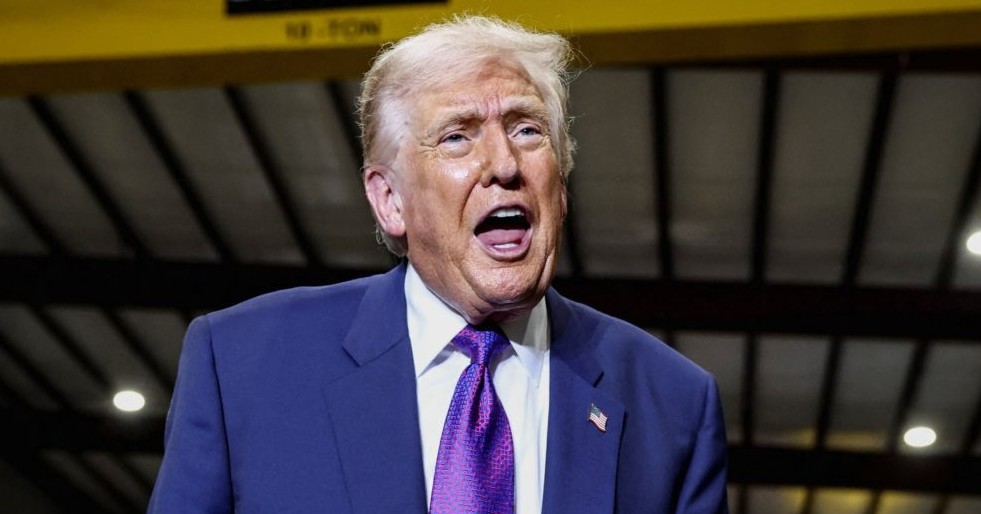
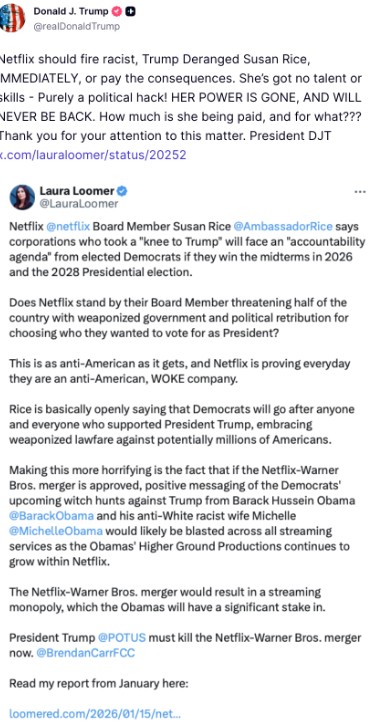
President Donald Trump has publicly called on Netflix to remove Susan Rice from its board of directors.
The statement is direct.
The target is clear.
And the message extends far beyond the internal governance of a private company.
Susan Rice has served on Netflix’s board since 2018. A former National Security Advisor and senior official associated with the Obama administration, she represents a well-known Democratic political figure. That political association is precisely what Trump is challenging.
This is not a dispute over a specific film or series. It is a symbolic confrontation between political power and cultural power.
Susan Rice’s Actual Role at Netflix
Before drawing conclusions, it is essential to separate perception from governance reality.
A board member:
-
does not approve individual scripts
-
does not decide casting choices
-
does not manage the recommendation algorithm
The role is strategic: oversight, governance, risk management, and long-term direction.
There is no public evidence indicating that Susan Rice directly shapes Netflix’s editorial decisions.
The criticism therefore centers less on operational influence and more on political affiliation.
The Legal Reality: Netflix Is Not Subject to Presidential Directive
Netflix is a publicly traded company.
Its board of directors answers to:
-
shareholders
-
corporate governance rules
-
regulatory obligations
A president cannot require the removal of a board member without a legal basis.
At this stage, no formal procedure or regulatory action has been initiated. The situation remains a public political statement, not an institutional measure.
That distinction matters. The impact is political, not legal.
An Open Confrontation Between Executive Power and Cultural Power
Netflix is not a minor player.
With hundreds of millions of global subscribers, the platform has become a significant cultural force. It influences narratives, social representation, and collective imagination.
In that context, targeting Netflix means targeting a symbol of contemporary cultural influence.
The presence of former political officials on corporate boards is not unusual. What is new is the explicit politicization of those appointments.
The debate is no longer purely economic. It has become ideological.
What This Political Episode Signals
Three broader dynamics are visible:
-
The increasing overlap between politics and corporate governance
-
The growing perception of streaming platforms as ideologically aligned actors
-
The normalization of direct confrontation between executive authority and private corporations
It would be excessive to frame this as an immediate institutional crisis.
It would be equally naive to dismiss it as routine rhetoric.
The episode reflects a larger shift: cultural companies are no longer viewed as neutral actors.
A Battle of Influence, Not a Governance Dispute
There is no indication that Netflix intends to alter its board composition in response to the statement.
But structural change may not be the immediate objective.
In an environment where attention functions as political currency, the president’s statement operates as a signal directed toward multiple audiences:
-
voters
-
large technology companies
-
media institutions
The issue is not solely whether Susan Rice remains on the board.
It concerns the evolving role of cultural corporations within contemporary power structures.
And that debate is far from settled.


