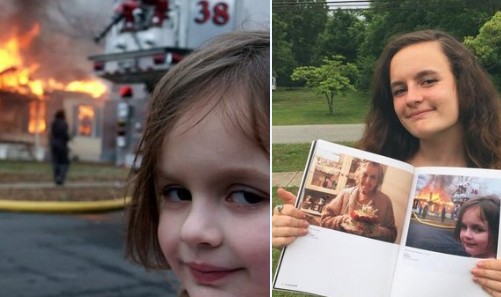
A photograph taken in 2005 in North Carolina continues to circulate widely nearly two decades after it was captured. Known online as Disaster Girl, the image shows a young girl smiling in front of a burning house during a controlled fire organized by the fire department in the town of Mebane.
Originally, the photo was a simple family snapshot taken by the girl’s father, with no intention of public distribution. Several years later, however, the image began circulating on forums and social media platforms before being widely remixed and shared. The child’s ambiguous smile became a recurring symbol of ironic chaos, frequently used in edited images depicting disasters, explosions, or apocalyptic scenarios.
For more than a decade, the meme was used freely across the internet, without legal structure or financial compensation for its creators. Like many viral images, it gradually slipped out of its creators’ control and into collective online ownership.
In April 2021, a turning point occurred. The original image was sold as an NFT for 180 Ethereum, representing approximately $473,000 at the time of the transaction. The sale was carried out by the Roth family, Zoë Roth, who appears in the photograph, and her father, the photographer and rights holder, with the support of a manager specializing in meme monetization.
Contrary to some claims circulated online, the full amount was not received by Zoë Roth alone. The proceeds were distributed among rights holders, intermediaries, and the platforms involved, according to contractual agreements. Zoë Roth later stated publicly that part of the funds was used to repay student loans and to make charitable donations.
The sale reignited a broader debate around intellectual property in the age of social media. Viral images, often perceived as belonging to the internet as a whole, can generate significant economic value long after their initial circulation.
The Disaster Girl case has become emblematic of a wider phenomenon, creators attempting to reclaim control over works that became public-facing while remaining legally protected. While NFT technology remains controversial, in this instance it served as a mechanism to reassign value to an image that had been exploited freely for years.
Nearly twenty years after it was taken, the smile of Disaster Girl continues to illustrate the contradictions of internet culture, caught between virality, collective appropriation, and delayed recognition of creators.