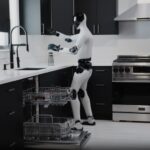
The clip is short, almost abrupt.
A humanoid robot lifts its leg, strikes, recovers its footing, and corrects its posture. No pause. No visible stiffness. The motion is fast, asymmetric, and risky. And yet, it holds.
The robot is called Unitree H1, developed by Unitree Robotics.
This video acts as a very clear marker: this is where humanoid robotics truly stands today.
Why these movements seem impossible for a machine
A biped humanoid robot is inherently unstable.
At every moment, its center of gravity must remain within an extremely narrow margin to avoid falling. Add a dynamic action—lifting a leg, accelerating a limb, absorbing recoil and the problem becomes a physical nightmare.
For humans, this control is largely subconscious.
For a robot, every correction depends on:
-
ultra-responsive inertial sensors
-
precise physical models of the body
-
actuators capable of delivering torque without delay
The Unitree H1 executes these movements with no visible slowdown. That means computation, transmission, and correction occur within milliseconds. At this scale, the slightest error would result in an immediate fall.
What makes the Unitree H1’s agility genuinely exceptional
This is not a robot that “knows how to fight.”
It is a robot that knows how not to fall, even when physics is actively working against it.
The movements shown in the video require:
-
instantaneous redistribution of mass
-
anticipation of imbalance before it becomes irreversible
-
absorption of energy without stiffening the structure
In other words, the robot is not merely following a predefined trajectory. It is physically adapting to what is happening in real time. This level of agility is precisely what most humanoid robots have lacked until now.
What this video reveals about the real state of humanoid robots
For years, public discourse has focused on artificial intelligence, language models, and conversation.
This video highlights a less comfortable truth: without mastering the body, intelligence remains unusable in the real world.
The Unitree H1 shows that humanoid robotics has crossed a fundamental threshold:
-
a shift from demonstrative motions to risky, dynamic movements
-
a shift from static posture to controlled instability
-
a shift from fragile machines to systems that can absorb impact
This is not yet a fully autonomous general-purpose robot. But it is already an artificial body capable of technical movements once limited to highly experimental, prohibitively expensive platforms.
Why this demonstration marks a turning point
What makes this video go viral is not just how impressive it looks.
It is the discomfort it creates.
It makes no promises.
It does not speculate about the future.
It simply shows a humanoid robot executing complex technical movements here and now.
And the implication is hard to ignore: humanoid robots are no longer confined to slow walking or staged demos. They are beginning to master agility, balance, and rapid movement three of the hardest problems in modern robotics.
This video is not a prediction.
It is a snapshot of reality.