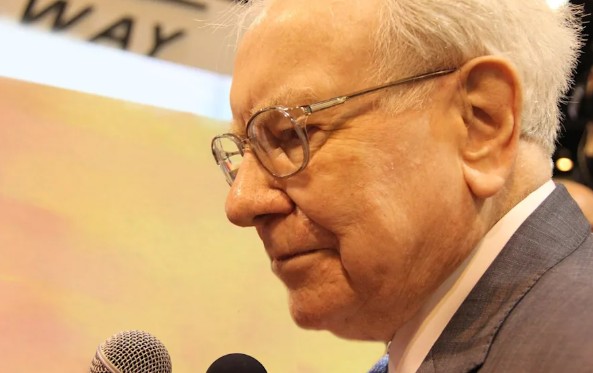
When Warren Buffett speaks, Wall Street pays attention.
At 95 years old, the legendary investor has lived through nearly every major financial crisis of the modern era, including the 1973 market crash, Black Monday in 1987, the dot-com bubble, the 2008 financial crisis, and the pandemic-driven market turmoil of 2020.
That is why a single sentence he recently shared during Berkshire Hathaway’s annual meeting is generating so much discussion:
“The casino has gotten very attractive to people.”
Behind those eight words lies a much broader warning about the current state of the stock market.
U.S. equities continue to hit record highs, artificial intelligence is fueling investor enthusiasm, and valuations in some parts of the market are beginning to resemble periods that ended badly in the past.
So, are investors making the same mistakes that led to the collapse of the dot-com bubble?
Why Warren Buffett Is Comparing the Stock Market to a Casino
Buffett has used a simple analogy for years to describe financial markets.
According to him, the stock market is like a church with a casino attached to it.
The church represents long-term investing: buying quality businesses, exercising patience, and building wealth over decades.
The casino represents speculation: chasing quick profits, making emotional decisions, and treating the market like a game.
What concerns Buffett today is not that the casino exists.
It is that more investors appear to be spending their time there.
The rise of commission-free trading platforms, social media-driven investing, meme stocks, and fear of missing out (FOMO) has created an environment where speculation often receives more attention than fundamentals.
As Buffett explained:
“We’ve never had people in a more gambling mood than now.”
That statement may sound dramatic, but several market indicators suggest investors are indeed taking on increasing levels of risk.
The S&P 500 Shiller CAPE Ratio Is Approaching Historic Levels
One of the most closely watched valuation metrics among professional investors is the Shiller CAPE Ratio (Cyclically Adjusted Price-to-Earnings Ratio).
Unlike a traditional P/E ratio, the CAPE ratio measures stock valuations using inflation-adjusted earnings over the previous ten years.
The goal is to smooth out short-term fluctuations and provide a clearer picture of market valuation.
As of June 2026, the S&P 500 CAPE ratio sits above 41.
To put that into perspective:
| Period | Approximate CAPE Ratio |
|---|---|
| Historical Average | 17 |
| Before the 1929 Crash | 32 |
| Dot-Com Bubble Peak (2000) | 44 |
| June 2026 | 41 |
In other words, U.S. stocks are currently trading at more than double their long-term average valuation.
This does not guarantee a market crash.
It does suggest that investors are paying exceptionally high prices for future earnings.
What Happened the Last Time Stocks Were This Expensive?
History never repeats itself perfectly.
But it often rhymes.
The last time the CAPE ratio approached current levels was during the dot-com bubble.
In the late 1990s, investors became convinced that the internet would transform the global economy.
They were right.
What they got wrong was how much they were willing to pay for that future growth.
When expectations eventually collided with reality, the Nasdaq lost nearly 78% of its value between 2000 and 2002.
Hundreds of companies disappeared.
Even promising businesses saw their valuations collapse.
The comparison with 2026 is not perfect.
Today, companies such as NVIDIA, Microsoft, and Alphabet generate substantial profits and dominate key sectors of the economy.
However, enthusiasm surrounding artificial intelligence has pushed certain valuations to levels rarely seen in modern financial history.
The danger may not be an economic collapse.
The danger is that expectations become impossible to meet.
Are Retail Investors Taking Too Much Risk?
One of Buffett’s biggest concerns appears to be investor behavior itself.
During periods of market euphoria, many people forget a simple principle:
The higher the price you pay, the lower your potential future return.
When markets rise quickly, it becomes easy to assume gains are inevitable.
That mindset appeared before:
- The 1929 stock market crash
- The dot-com bubble in 2000
- The housing crisis in 2008
- The meme stock frenzy in 2021
In each case, investors convinced themselves that “this time is different.”
History suggests markets remain cyclical.
Periods of extreme optimism are often followed by periods of adjustment.
Does This Mean a Market Crash Is Coming?
No.
And that is probably the most important point.
Buffett did not predict a crash.
He did not forecast a recession.
He did not tell investors to sell their stocks.
Instead, he highlighted a growing disconnect between prices and fundamentals.
No indicator can accurately predict whether a correction will begin in three months, one year, or three years.
Markets can remain expensive far longer than many investors expect.
The real mistake is assuming that recent gains guarantee future returns.
How Investors Can Protect Their Portfolios
History offers a remarkably consistent lesson.
Investors who attempt to predict market crashes often fail.
Investors who focus on owning high-quality businesses tend to perform better over the long run.
Since January 2000, despite:
- The dot-com crash
- The 2008 financial crisis
- The COVID-19 pandemic
- Multiple bear markets
The S&P 500 has delivered total returns exceeding 700%.
The best protection against market volatility is not prediction.
It is quality.
Companies with strong balance sheets, durable competitive advantages, healthy cash flow, and proven profitability have historically recovered from downturns and continued creating shareholder value.
The Real Lesson Behind Buffett’s Warning
Buffett’s comments are often oversimplified.
He is not saying investors should abandon the stock market.
He is reminding investors that markets can become overly optimistic.
When speculation dominates decision-making, valuations become fragile.
When expectations become unrealistic, disappointment can be severe.
For long-term investors, the lesson remains the same as it was twenty years ago:
Buy quality businesses, avoid chasing hype, and stay disciplined when everyone else becomes euphoric.
Because throughout market history, the most expensive mistakes are rarely made during periods of fear.
They are usually made when everything seems easy.