
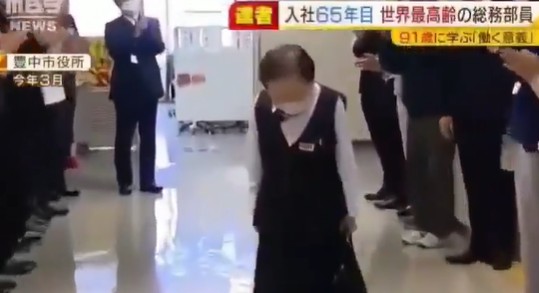
Yasuko Tamaki is a Japanese administrative employee whose professional career has been officially recognized by Guinness World Records for a very specific reason: she worked for the same organization, in the same position, for a longer continuous period than anyone else on record.
She joined a municipal administration in Japan in 1961, at the age of 26, and remained in the same role until 2026, when she was 91 years old. This uninterrupted continuity — same employer, same job — is the defining criterion of the record, far more than the sheer length of her working life.
Such a career path has become extremely rare in developed economies, where professional trajectories are now shaped by job mobility, restructuring, and career changes.
What the world record for seniority with the same employer actually measures
Guinness World Records validated this record using a narrow and clearly defined criterion:
-
continuous employment
-
with the same organization
-
in the same or nearly identical role
The record does not measure:
-
individual performance
-
productivity
-
working conditions
-
workload intensity
It is a record of institutional continuity, not endurance, efficiency, or professional excellence.
In this context, Yasuko Tamaki’s case stands out because it combines three elements that are now extremely uncommon: long-term employment stability, absence of role changes, and continued professional activity at a very advanced age.
Yasuko Tamaki, a Japanese woman, holds the world record for longest tenure with the same employer.
She worked in the same organization, in the same role, from 1961 to 2026 — 65 years, until age 91.
A rare case of professional continuity, shaped by a system that no longer… pic.twitter.com/nFGQsbErLl
— Enzvia (@enzvia) January 26, 2026
Commonly cited working hours should be treated with caution
Many articles and social media posts mention daily working hours of 5:30 a.m. to 5:30 p.m. over several decades. While widely repeated, these figures require careful interpretation.
In Japan from the 1960s through the 1980s:
-
administrative schedules were often extended
-
on-site presence did not always equal continuous active work
-
working rhythms evolved significantly over time
There is no publicly available documentation confirming that these hours were applied unchanged for 65 consecutive years. It is therefore more accurate to view them as historical reference schedules, not a constant lifelong workload.
Why this record would be nearly impossible to reproduce today
More than an individual achievement, this record reflects a specific historical and institutional context:
-
post-war Japan
-
highly stable public-sector employment
-
limited professional mobility
-
flexible or postponed retirement structures
In most modern economies, the combination of “same employer + same role + over 60 years” has become structurally unlikely, regardless of personal motivation or commitment.
This record is therefore less the result of an extraordinary personal choice than the product of a labor system that has largely disappeared.
What should be taken away from Yasuko Tamaki’s career
Yasuko Tamaki’s world record for seniority is remarkable, but it should be interpreted carefully:
-
it does not glorify overwork
-
it is not a career model to emulate
-
it does not prescribe working longer as a social ideal
Its value is primarily historical and descriptive. It documents a form of professional stability that was once possible, sometimes expected, and institutionally supported.
That structural rarity — far more than the individual feat itself — is what truly makes this record noteworthy today.


