Comparing job offers or planning a move within Canada involves more than looking at the salary. An income can sound attractive and still leave little room after rent, transportation, and household expenses.
The cost of living in Canada depends on your city, housing arrangement, and household composition. A national average isn’t enough to decide where to settle.
This guide helps you compare expenses across provinces and territories, understand the available indicators, and build your own budget. For a closer look at individual markets, explore our guide to the cost of living in Vancouver.
What Is a Living Wage in Canada?
A living wage is a benchmark calculated using a defined basket of expenses and specific household assumptions. It isn’t the legal minimum wage or a guarantee of comfort for every household.
Calculations may account for taxes, payroll deductions, and government benefits. Check the year, geographic coverage, and household types before comparing two rates.
In British Columbia, Living Wage BC’s 2026 methodology combines three household types. It produces a rate of CAD 28.55 per hour for Metro Vancouver and CAD 28.20 for Greater Victoria. These are composite indicators, not identical personal budgets for everyone.
The methodology excludes expenses such as debt repayments and retirement savings. A living wage therefore shouldn’t be presented as an income that automatically supports a comfortable lifestyle and substantial savings. See the Living Wage BC 2026 report and methodology.
For your own decision, start with the expenses you’ll actually need to cover.
How Much Should Different Households Budget?
A person living alone, a couple, and a family face different expenses. Household size is only part of the picture: the number of incomes and opportunities to share costs matter, too.
| Household situation | What to check first |
|---|---|
| Single adult | Rent paid alone or shared, transportation, fixed bills, and a financial cushion. |
| Couple without children | Combined take-home income, shared expenses, each person’s commute, and income stability. |
| Family with children | Bedroom requirements, childcare, school schedules, transportation, and children’s expenses. |
| Single parent | How housing, work, and childcare fit together, with employment income coming from one adult. |
Compare expenses with your available take-home income, rather than the gross salary quoted in a job offer.
A useful calculation is:
Monthly budget to cover = regular expenses + annual expenses divided by 12 + savings goals.
Include any debt repayments that apply to you. Avoid counting on a bonus, benefit, or raise until you’ve confirmed the amount and conditions.
Housing: Comparable Rental Figures Across Cities
Housing deserves its own comparison. Average rent paid by existing tenants isn’t the same measure as an advertised asking rent or the rent paid when a unit changes tenants.
The table below uses one rental category: two-bedroom purpose-built apartments that changed tenants, in selected census metropolitan areas.
| Metropolitan area | Average monthly rent, October 2025 |
|---|---|
| Vancouver | CAD 2,696 |
| Toronto | CAD 2,547 |
| Ottawa | CAD 2,155 |
| Halifax | CAD 2,058 |
| Calgary | CAD 1,836 |
| Montréal | CAD 1,644 |
| Edmonton | CAD 1,600 |
Source: CMHC, 2025 Rental Market Report. These figures cover rent only and refer to metropolitan areas. They aren’t a survey of advertised rents in 2026. See the CMHC report and rental data.
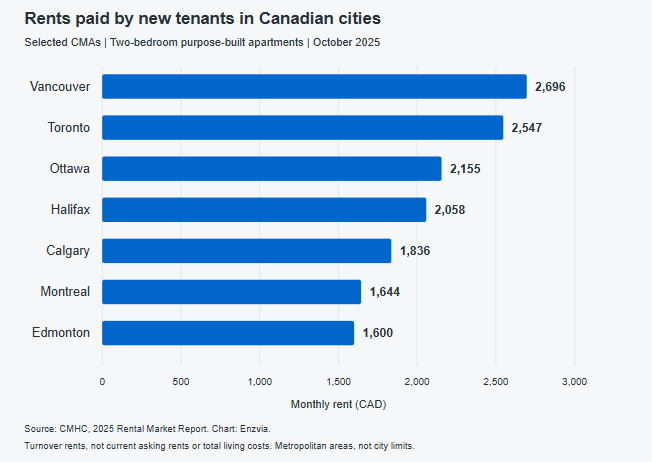
Original chart: Enzvia. The same rental category and observation period are used for all seven markets.
This is a starting point, not a complete cost-of-living ranking. It doesn’t show what your household will spend on transportation, groceries, or childcare.
Before choosing a destination, replace these benchmarks with several available listings that match your actual needs.
Cost of Living by Province and Territory
Ontario: Compare the Address and the Commute
Whether you’re considering Toronto, Ottawa, or another Ontario city, assess housing alongside each household member’s travel needs.
A cheaper apartment may lose some of its appeal if it adds parking charges, extra travel, or a second car. Check what’s included in the lease, too: heat, water, laundry, and parking can change the comparison.
For a hybrid job, calculate commuting costs using the number of in-office days actually required.
British Columbia: Identify the Market and Housing Type
Don’t apply a Metro Vancouver figure to the entire province or assume a regional average describes a particular address.
For Vancouver or Victoria, start with your bedroom requirements and locations that work for your routine. Then add utilities and transportation.
Our detailed Vancouver budget guide explains the differences between rental categories and provides illustrative household budgets.
Quebec: Compare Household Income After Deductions
For Montréal, Québec City, or another municipality, use take-home income calculated for your circumstances.
If you have children, check applicable childcare fees, eligibility conditions, and actual space availability before finalizing your budget. Review which utilities are included in the rent as well.
A lower rent alone doesn’t establish whether a job offer will leave your household better off.
Alberta: Consider Housing and Car Costs Together
In Calgary or Edmonton, check the routes to work, grocery stores, and your regular activities.
If you’ll keep a car, include insurance, financing where applicable, fuel, parking, and maintenance. For public transit, compare your expected trips with the cost of a pass.
Our guide to the cost of living in Calgary with or without a car includes an example showing how transportation can absorb a rent saving.
Manitoba: Budget for Housing Over a Full Year
In Winnipeg or elsewhere in Manitoba, ask how the property is heated and which services you’ll pay for separately.
An annual view is more useful than an estimate based on one bill. Add transportation and moving costs before comparing expenses with your available income.
Saskatchewan: Start With Your Workplace
For Regina, Saskatoon, or another community, begin with the work location and schedule.
Identify suitable housing, then compare the complete costs. If the job involves work-related travel, ask which expenses the employer covers.
Nova Scotia: Don’t Treat Halifax as the Whole Province
Halifax data describes a specific market. For another municipality, research housing and transportation in that destination.
If you’re moving with children, consider housing, childcare, and work schedules together. A budget that balances on paper also needs to function in daily life.
New Brunswick: Compare Cities Individually
For Moncton, Fredericton, or Saint John, prepare a separate list of available properties and transportation expenses.
Don’t choose a destination solely because a province has a reputation for affordability. The relevant comparison is the home you can actually rent and the income your household will receive.
Prince Edward Island: Check Rental Conditions
In Charlottetown or another community, confirm the lease duration, availability dates, and included services.
If your income varies throughout the year, build a budget that covers fixed expenses during quieter months.
Newfoundland and Labrador: Be Specific About Your Destination
A move to St. John’s and a move to another community need separate calculations.
Check housing arrangements and transportation, then include planned trips to visit family. Set aside a monthly amount for those occasional expenses.
Yukon: Price the Move Before You Leave
For Whitehorse or another community, obtain specific information about available housing, utilities, and furnishings.
If an employer offers moving assistance or accommodation, request the written terms: the amount, duration, and expenses you’ll still need to cover.
Northwest Territories: Examine the Complete Job Offer
For Yellowknife or another destination, compare salary with the practical terms of employment.
Housing, transportation, personal travel, and necessary equipment should appear in your calculation. A package with benefits isn’t directly comparable to a salary without them.
Nunavut: Build a Community-Specific Budget
For Iqaluit or another community, avoid automatically adopting a budget prepared for a large southern Canadian city.
Seek local information about housing, included services, everyday purchases, and transportation. Identify which costs are confirmed, which are covered, and which still need estimates.
How to Build Your Budget Before Moving
Use the same household composition and needs when comparing destinations. Comparing one person sharing an apartment in one city with a family renting a house elsewhere won’t produce a useful answer.
Work through these steps:
- Define your housing needs. Decide on bedroom count, whether you’ll share, and suitable locations.
- Collect comparable listings. Record the dates and included services.
- Calculate transportation. Include work, school, groceries, and regular activities.
- Add personal expenses. Account for food, phone service, insurance, and health needs.
- Spread periodic expenses across the year. Include maintenance, planned travel, and annual renewals.
- Set a contingency target. Keep predictable expenses separate from unexpected costs.
- Compare the total with confirmed take-home income.
Before leaving, take the opportunity to find and cancel unwanted subscriptions. That won’t fix an unaffordable rent, but it can prevent forgotten charges from following you into your new budget.
Frequently Asked Questions About Living Costs in Canada
What Salary Do You Need to Live Comfortably in Canada?
There isn’t one amount that works everywhere. First define your household, city, housing needs, debts, and savings goals. Then calculate the take-home income needed to support that budget.
Which Canadian Province Has the Lowest Cost of Living?
A useful comparison requires equivalent needs and comparable data. Lower rent alone doesn’t establish that your household’s total expenses will be lower.
Is a Living Wage the Same as the Minimum Wage?
No. The minimum wage is a legal pay floor. A living wage is a calculated benchmark based on a particular methodology and basket of expenses.
Can You Use 2025 Rental Data to Plan a 2026 Budget?
Yes, as clearly dated historical context. Before committing to a move, check available properties, current asking prices, and lease conditions.
The Best Benchmark Is a Budget You Can Maintain
Choosing where to live involves more than finding the lowest rent. Your plan should cover regular bills, predictable expenses, and a financial cushion suited to your circumstances.
Use national data to identify differences, local guides to explore your options, and your own quotes, listings, and income figures to make the final decision.
Get practical budgeting tips, discover useful tools, and find ways to save on everyday expenses. Subscribe to Enzvia Signals.