An apartment near the SkyTrain, groceries within walking distance, and mountains on the horizon: Vancouver has plenty of appeal. Before choosing a neighbourhood, though, there’s a more practical question to answer. How much money will you have left after rent and everyday expenses?
Your budget depends as much on your housing arrangement as on how you get around. Sharing with a roommate, living with a partner, or keeping a car can change the calculation considerably.
This guide builds on our overview of the cost of living across Canadian provinces and cities. Below, we separate documented rental figures from illustrative budgets so you can put together an estimate that fits your circumstances.
Start by Comparing the Right Rental Figures
A city’s average rent isn’t necessarily what you’ll pay when you move there.
In its 2025 Rental Market Report, CMHC reports the following figures for the Vancouver census metropolitan area:
- CAD 2,363 per month on average for a two-bedroom purpose-built rental apartment.
- CAD 2,696 per month for two-bedroom purpose-built apartments that changed tenants.
- CAD 2,900 per month on average for a rented two-bedroom condominium apartment.
These figures describe different parts of the market. They cover 2025 and the metropolitan area, rather than just the City of Vancouver or today’s available listings. See the CMHC rental figures and methodology.
When planning your move, compare actual listings with similar bedroom counts, locations, and features.
Check what each price includes. An apartment with heat and hot water included isn’t directly comparable to one where you pay those bills separately. Laundry, parking, and pet-related charges deserve a closer look, too.
The cheapest advertised rent won’t necessarily leave you with the lowest monthly expenses.
How Rents for New Tenants Have Changed
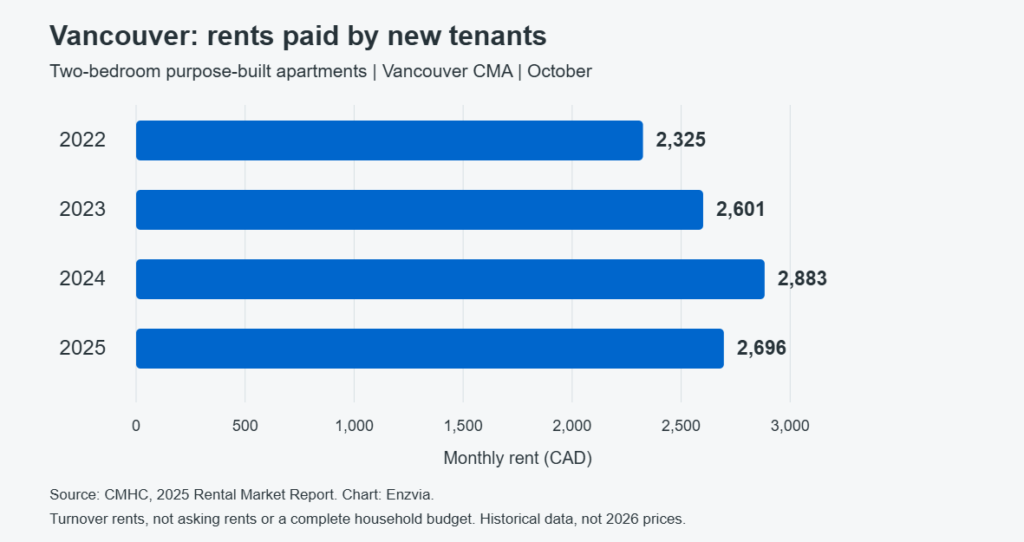
The chart below follows one consistent measure: average rent for two-bedroom purpose-built apartments that changed tenants.
| Year, October observation | Average monthly rent |
|---|---|
| 2022 | CAD 2,325 |
| 2023 | CAD 2,601 |
| 2024 | CAD 2,883 |
| 2025 | CAD 2,696 |
Source: CMHC, 2025 Rental Market Report. Chart: Enzvia. These historical figures are not a survey of advertised rents in 2026.
Use this trend as background for your search. An average doesn’t guarantee that a suitable apartment will be available at that price in your preferred neighbourhood.
Calculate Your Commute Before Choosing an Address
A lower rent can become less attractive if the location means keeping a car, paying for parking, or making more trips.
When checked in November 2026, TransLink adult monthly passes were listed at:
- CAD 117.20 for one zone.
- CAD 156.70 for two zones.
- CAD 211.65 for three zones.
Fares depend on the mode of travel, zones, and timing. Bus trips use a one-zone fare, while different rules apply to SkyTrain and SeaBus trips. Check TransLink’s official fares and zones against your route.
Before signing a lease, check the commute at the times you’ll actually travel. Look at evening service, transfers, and access to a grocery store as well.
If you work from home part of the week, compare a pass with the cost of your expected individual trips. A monthly pass isn’t automatically the least expensive option.
If you’re keeping a car, list financing payments, insurance, fuel, parking, and maintenance separately. A single budget line labelled “gas” leaves out much of the cost.
Two Sample Monthly Budgets
The following figures are illustrative Enzvia budgets, not measured averages for Vancouver households.
Both examples assume a hypothetical two-bedroom apartment renting for CAD 2,700 per month. This rounded amount is a calculation input, not a verified 2026 listing price.
The first scenario covers one person splitting the apartment equally with another adult. The second covers a couple without children sharing the entire apartment. Neither scenario includes a car.
| Monthly expense | One person sharing with a roommate | Couple, household total |
|---|---|---|
| Hypothetical rent | CAD 1,350 | CAD 2,700 |
| Transit, one-zone pass per adult | CAD 117.20 | CAD 234.40 |
| Groceries, chosen allowance | CAD 450 | CAD 800 |
| Utilities, internet, and tenant insurance, chosen allowance | CAD 120 | CAD 200 |
| Phone, chosen allowance | CAD 80 | CAD 140 |
| Health, clothing, and personal spending, chosen allowance | CAD 100 | CAD 180 |
| Savings and contingency, chosen target | CAD 200 | CAD 400 |
| Illustrative monthly total | CAD 2,417.20 | CAD 4,654.40 |
These totals are neither official minimums nor universal income requirements. The allowances may be insufficient depending on your diet, health needs, commitments, and leisure spending.
The examples exclude childcare, debt repayments, tuition, travel, and moving costs. Add those expenses before comparing the budget with your income.
To personalize the table, replace the rent with a realistic listing price, then substitute your own figures for expenses you already know. Keep the assumptions visible so you can adjust them after your first few months.
Build Grocery and Subscription Costs Around Your Habits
To estimate groceries, plan a week of meals you’d realistically eat. Include breakfast, lunches for work, and household supplies. Then price the basket at a store you could conveniently reach from the apartment you’re considering.
That will be more useful than a budget built around meals you won’t cook.
Keep groceries separate from restaurants, coffee shops, and delivery orders. You can then decide where to cut back without treating every food expense as unavoidable.
Review your existing contracts as well. Our guide to finding and cancelling unwanted subscriptions can help you clear out forgotten charges before moving.
Cancelling a few subscriptions won’t make an unaffordable apartment affordable, but it can stop unnecessary spending from following you into your new budget.
How Much Income Should You Compare Against These Costs?
To assess whether the plan works, compare expenses with your available take-home income, after applicable payroll deductions.
In the roommate example, monthly expenses of CAD 2,417.20 against CAD 2,500 in take-home income would leave just CAD 82.80 beyond the listed categories. A small overlooked expense could absorb that difference.
The calculation shows how little room that particular scenario leaves. It doesn’t establish a suitable salary for every reader.
For couples, consider household income and how reliably it arrives. Two steady paycheques and one variable income don’t provide the same financial cushion, even when their annual averages look similar.
Leave room for a month that doesn’t go exactly to plan. Annual bills, unexpected trips, and replacement purchases don’t always arrive at convenient times.
Budget for Moving In, Too
Recurring expenses don’t tell the whole story.
Add moving costs, any temporary accommodation, missing furniture, and the items you’ll need to work or cook. Ask what payments will be required when you sign the lease and when each one is due.
A simple table with three columns is enough: expense, confirmed or estimated amount, and payment date.
This helps you distinguish between a monthly budget that works and a move that leaves you short of cash during the first few weeks.
For more ways to prepare, explore our guides to managing money and everyday expenses. The goal is to choose housing and routines you can maintain while leaving room to enjoy Vancouver.
Get practical budgeting tips, discover useful tools, and find ways to save on everyday expenses. Join curious readers subscribing to Enzvia Signals.