
Lower rent can make a move to Calgary appealing. But if the location means keeping two cars, paying for parking, and spending more time commuting, those savings can shrink quickly.
To estimate the cost of living in Calgary, compare housing and transportation together. Then add utilities, groceries, and room for expenses that don’t arrive every month.
This guide builds on our overview of the cost of living across Canadian provinces and cities. It combines documented rental figures with clearly labelled examples to help you build a budget around your circumstances.
How Much Does It Cost to Rent an Apartment in Calgary?
In its 2025 Rental Market Report, CMHC reports the following figures for the Calgary census metropolitan area:
- CAD 1,914 per month on average for a two-bedroom purpose-built rental apartment.
- CAD 1,836 per month for two-bedroom purpose-built apartments that changed tenants.
- CAD 2,030 per month on average for a rented two-bedroom condominium apartment.
These figures cover 2025, different rental categories, and the metropolitan area. They aren’t current advertised prices for every neighbourhood. See the CMHC report and rental data.
For your search, collect several comparable listings. Consider bedroom count, usable space, amenities, and the exact location.
Ask what’s included: heat, water, electricity, parking, and laundry. The advertised rent alone doesn’t tell you enough to compare two properties.
How Rents for New Tenants Have Changed
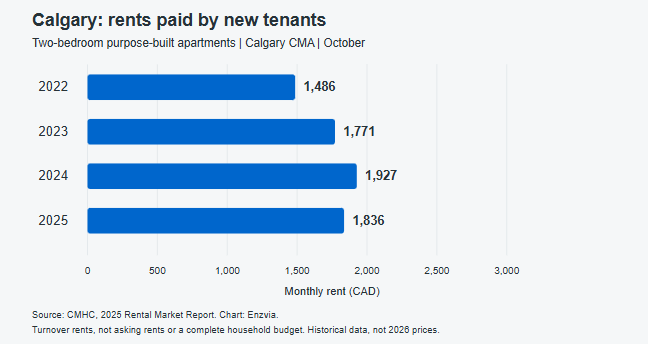
The following chart tracks one consistent measure: average rent for two-bedroom purpose-built apartments that changed tenants.
| Year, October observation | Average monthly rent |
|---|---|
| 2022 | CAD 1,486 |
| 2023 | CAD 1,771 |
| 2024 | CAD 1,927 |
| 2025 | CAD 1,836 |
Source: CMHC, 2025 Rental Market Report. Chart: Enzvia. Historical metropolitan-area figures, not a survey of advertised rents in 2026.
Use this trend to understand the market, then build your budget around properties that are actually available. Don’t plan your move on the assumption that an apartment at the average price will be available in your preferred location.
Can You Live in Calgary Without a Car?
That depends largely on where you need to go and when.
Before choosing an apartment, check three routes: work, groceries, and an activity you do regularly. Look at transfers, walking distances, and return-trip schedules.
A property may look close to a station on a map while being inconvenient for your actual commute. Check what happens if you miss a connection or finish work later than expected.
Calgary Transit’s 2026 adult fares are CAD 4 for a single fare valid for 90 minutes and CAD 126 for a monthly pass. See the official Calgary Transit fares.
For comparison, 32 separate CAD 4 fares cost CAD 128. If you use two separately paid fares per commuting day, that’s 16 days of travel. Compare your actual trips, transfers, and eligibility for other fare options before deciding.
Choose a pass around how you travel, rather than assuming you need one simply because you live in the city.
Does Cheaper Rent Offset the Cost of a Car?
Consider two hypothetical options for the same adult:
- A home renting for CAD 1,900, with a location that works for their public transit needs.
- A home renting for CAD 1,600, where they plan to keep a car.
These rents are comparison inputs, not prices collected from listings. The car allowance below is also illustrative and should be replaced with your own quotes and expenses.
| Monthly expense | Public transit option | Car option |
|---|---|---|
| Hypothetical rent | CAD 1,900 | CAD 1,600 |
| Transportation | CAD 126 | CAD 650 |
| Groceries, chosen allowance | CAD 450 | CAD 450 |
| Utilities, internet, and tenant insurance, chosen allowance | CAD 200 | CAD 200 |
| Phone, chosen allowance | CAD 70 | CAD 70 |
| Personal spending and leisure, chosen allowance | CAD 180 | CAD 180 |
| Savings and contingency, chosen target | CAD 250 | CAD 250 |
| Illustrative monthly total | CAD 3,176 | CAD 3,400 |
In this example, saving CAD 300 on rent doesn’t cover the difference in transportation costs. The second option costs CAD 224 more per month, or CAD 2,688 over a year.
That result applies only to these assumptions. It changes if you own a car without financing, share trips, pay for parking, or receive a different insurance quote.
To calculate your own car allowance, separate:
- Financing or lease payments, if applicable.
- Insurance.
- Fuel.
- Parking at home and at your destinations.
- Maintenance and repairs.
- Tires and other periodic expenses.
If you already have a car, distinguish costs you’ll keep regardless of where you live from expenses a move could actually eliminate.
Also considering British Columbia? Our guide to the cost of living in Vancouver includes other rental figures and household scenarios. Compare individual categories and assumptions rather than placing the sample totals side by side.
Utilities and Heating: What to Ask Before Signing
Request a written list of the services included in the rent. If you’ll be responsible for some utilities, find out what you’ll be paying for and how the property is heated.
Where available, ask for consumption history or representative bills. An informal estimate based on a single month doesn’t give you much insight into a full year.
Also check:
- Whether usage is individually metered.
- Which service accounts you’ll need to open.
- Whether setup fees or deposits apply to your account.
- How shared expenses will be divided between roommates.
Avoid adopting another household’s utility budget without considering the property’s size, equipment, and occupancy patterns.
Groceries: Price a Basket You’ll Actually Use
Build your grocery estimate around a realistic week of meals. Include work lunches, snacks, and household supplies, then check prices at a store you could conveniently reach from your prospective home.
Keep groceries separate from restaurants, coffee shops, and delivery orders. You’ll be able to see where you can adjust spending without treating every food purchase as unavoidable.
Consider the logistics, too. A distant promotion becomes less useful if it requires an extra trip or encourages you to buy more than you’ll consume.
Before moving, review your existing subscriptions as well. Our guide to finding and cancelling unwanted subscriptions can help remove forgotten recurring expenses from your starting budget.
What Salary Do You Need to Live in Calgary?
Start with your available take-home income, then compare it with your complete expenses.
In our public transit example, take-home income of CAD 3,500 per month would leave CAD 324 beyond the categories already included. That balance isn’t automatically disposable income: it still needs to cover anything you’ve overlooked or excluded.
The examples don’t include childcare, debt repayments, tuition, travel, or significant health expenses. They therefore aren’t recommended minimum salaries or measures of the income needed to live comfortably.
If your income varies, plan for a weaker month as well. Check whether you could still cover housing and essential commitments without relying on a bonus or an additional contract.
Give Moving Costs Their Own Budget
Your first month may include moving expenses, temporary accommodation, furniture, and service setup costs.
Add the amounts required when signing the lease and the dates they’re due. If you’re arriving with a car, include the administrative steps and expenses that apply to your situation.
A simple three-column list works: confirmed amount, amount to verify, and payment date.
The right choice needs to work both during the move and in everyday life. In Calgary, that means choosing an address around your actual travel needs, then checking what remains after all your expenses—not just rent.
Know someone considering a move to Calgary? Share this guide to help them compare housing and transportation before choosing an address.