
US$50,205 in Dallas-Fort Worth, compared with US$42,296 in San Antonio. Those are the estimated annual incomes before taxes that a single adult needs to cover basic expenses, according to the MIT Living Wage Calculator’s 2026 tables.
The difference approaches US$8,000 a year, despite both estimates covering the same household type in the same state.
Understanding the cost of living in Texas requires looking beyond a statewide average. Housing matters, but transportation, health care, and child care can change the budget just as substantially.
This guide compares four major metropolitan areas: Dallas-Fort Worth, Houston, Austin, and San Antonio. All amounts are in US dollars. They describe modeled basic needs, without an additional budget for savings, vacations, or emergencies.
Alongside these estimates, it helps to review actual recurring expenses. Our guide to finding and canceling unwanted subscriptions offers a practical way to check those commitments.
Income Needed in Four Major Texas Metro Areas
The figures below use the annual income before taxes published in MIT’s metropolitan-area tables, updated February 15, 2026.
Three household situations are compared:
- One adult with no children.
- Two adults working full-time, with no children.
- Two adults working full-time, with two children.
For couples and families, the figures represent combined household income, not each adult’s salary.
Dallas-Fort Worth-Arlington
- One adult, no children: US$50,205
- Two working adults, no children: US$65,972
- Two working adults, two children: US$109,829
Austin-Round Rock-San Marcos
- One adult, no children: US$49,322
- Two working adults, no children: US$65,499
- Two working adults, two children: US$112,866
Houston-Pasadena-The Woodlands
- One adult, no children: US$46,160
- Two working adults, no children: US$61,927
- Two working adults, two children: US$103,983
San Antonio-New Braunfels
- One adult, no children: US$42,296
- Two working adults, no children: US$57,863
- Two working adults, two children: US$97,401
Source: MIT Living Wage Calculator, updated February 15, 2026. Annual household income before taxes, in USD. Figures for couples and families are combined household totals. Estimates cover basic needs and assume 2,080 working hours per worker annually.
The MIT calculator for Texas also provides statewide estimates. The metropolitan figures used here help distinguish destinations that shouldn’t be treated as a single cost-of-living market.
Original Enzvia Chart
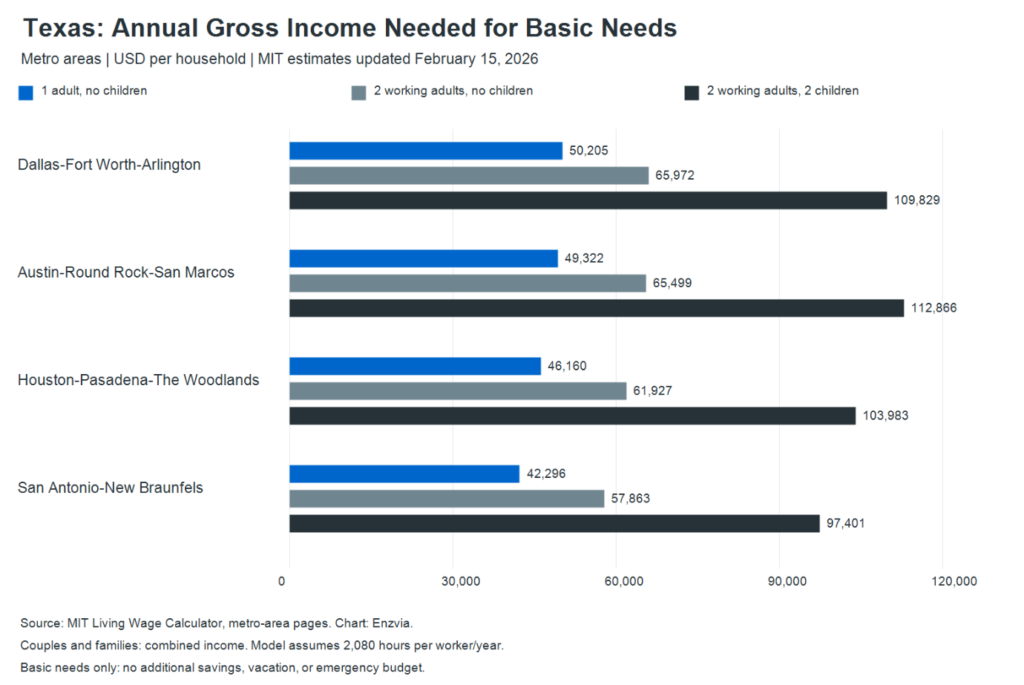
Chart: Enzvia, based on MIT estimates. Household income before taxes; basic needs only.
For Single Adults, Housing Explains Part of the Gap
San Antonio has the lowest estimated income requirement for a single adult in this comparison. Dallas-Fort Worth has the highest.
Housing contributes to that difference. For the same household type, the model includes annual housing costs of:
- US$18,416 in Dallas-Fort Worth.
- US$17,779 in Austin.
- US$15,276 in Houston.
- US$12,943 in San Antonio.
These are modeled housing budgets, not current asking rents for specific apartments. They shouldn’t be presented as average prices from available rental listings.
Between Dallas-Fort Worth and San Antonio, the housing difference reaches US$5,473 a year, or approximately US$456 a month.
That deserves attention when comparing job offers. A slightly higher salary in one metro area may be absorbed by housing costs, depending on the neighborhood and lease.
With Two Children, the Comparison Changes
Austin isn’t the most expensive location in our table for a single adult. It becomes the most expensive for a household with two working adults and two children.
Child care helps explain that change. For this household, the model includes annual child care budgets of:
- US$23,856 in Austin.
- US$21,148 in Dallas-Fort Worth.
- US$20,233 in Houston.
- US$18,881 in San Antonio.
Austin’s figure works out to approximately US$1,988 a month. It isn’t a quote from a child care provider: children’s ages, schedules, arrangements, and available places can change the actual cost.
The number of working adults also matters. A household with one working adult isn’t directly comparable with one where both adults work. Child care, transportation, and taxes may differ.
Simply dividing a family’s required income in half doesn’t establish what a single adult needs to earn.
What Does That Mean Per Month After Taxes?
Gross income is useful when comparing salaries. Planning expenses requires looking at the amount available after taxes.
For one adult with no children, here are the model’s annual after-tax requirements divided by 12:
Monthly basic-needs budget after taxes
For one adult without children:
- Dallas-Fort Worth-Arlington: approximately US$3,565 per month.
- Austin-Round Rock-San Marcos: approximately US$3,506 per month.
- Houston-Pasadena-The Woodlands: approximately US$3,297 per month.
- San Antonio-New Braunfels: approximately US$3,034 per month.
Enzvia calculation: MIT’s annual after-tax income requirement divided by 12, rounded to the nearest dollar. These are modeled basic-needs budgets, not personalized paycheck estimates.
Dividing the figures into monthly amounts doesn’t turn them into comfortable-living budgets. They still reflect the model’s categories and assumptions.
Personal debt payments and other commitments need separate attention. Our guide to budgeting before using buy now, pay later explains why even a small installment belongs in the broader picture of what you owe.
Basic Needs and Comfortable Living Require Different Budgets
The MIT methodology estimates the earnings needed to cover a household’s basic needs. These include housing, food, health care, transportation, applicable child care, communications, other necessities, and associated taxes.
The 2026 edition draws on sources from different years, adjusted to December 2025 dollars.
The model isn’t a complete budget for savings, vacations, and emergencies. Those goals need to be added explicitly when planning a move.
A useful approach is to build two columns:
Regular expenses: the housing you’re considering, bills, food, transportation, health care, child care, and existing commitments.
Personal financial goals: savings, irregular expenses, projects, leisure, and building a reserve.
Keeping them separate makes the decisions visible. It also avoids adding an arbitrary percentage and presenting the result as a universal salary needed to “live comfortably.”
Is US$60,000 a Good Salary in Texas?
For a single adult without children, US$60,000 before taxes exceeds all four basic-needs income estimates shown here.
That doesn’t mean the same salary supports every lifestyle. More expensive housing, different health coverage, a car loan, or student loan payments can reduce the room in a budget.
For two working adults with two children, US$60,000 in total household income falls below all four estimates.
Household composition matters as much as location. A salary offer becomes meaningful only after identifying how many people it needs to support.
Neighborhoods and Commutes Can Matter as Much as the Metro
The locations compared here are metropolitan areas, extending beyond individual city limits.
A budget for Dallas-Fort Worth-Arlington doesn’t describe every Dallas neighborhood. The same caution applies to the other locations.
Before choosing cheaper housing, examine:
- The commute at your usual working hours.
- How many vehicles the household needs.
- Insurance quotes for your circumstances.
- Parking costs and possible tolls.
- Access to school or child care.
- Which utilities and charges the housing includes.
A rent saving may remain worthwhile after those checks. Additional transportation costs can also reduce it.
Compare housing and transportation together, using realistic addresses rather than a broad average.
Turn the Estimates Into a Moving Budget
Start with the household type that matches your situation. Then replace major modeled costs with researched amounts: housing listings, insurance quotes, health coverage details, and child care prices.
Separate recurring expenses from setup costs. A security deposit, moving charges, and initial furniture purchases don’t arrive on the same schedule as an ordinary monthly bill.
If the planned work is self-employment, distinguish revenue from available personal income. Invoiced amounts still need to cover business expenses and tax obligations. Our free invoice generator can help prepare billing documents; it doesn’t calculate the take-home income needed to live in Texas.
The estimates provide a consistent starting point. A stronger decision comes from comparing the proposed salary with specific housing, a realistic commute, and the household’s own expenses.
Useful Guidance for Your Next Financial Decision
Subscribe to Enzvia Signals for practical money-saving tips, useful tools, and clear explanations to help make sense of everyday expenses.