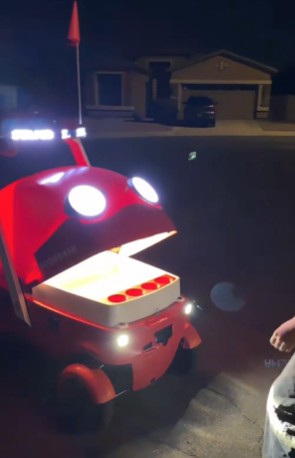
This is no longer a theoretical concept. The video shows Dot, an autonomous delivery robot tested by DoorDash, operating in real-world conditions inside a US residential neighborhood.
No staged demo. No controlled environment. A real delivery, captured as it actually happened.
What the video shows, concretely
Dot moves on its own along the street. It stops in front of a home. Its delivery compartment opens automatically. The customer retrieves the order. The robot continues on its route.
Observable facts, without interpretation:
-
autonomous low-speed movement
-
LED lighting for nighttime operation
-
secured compartment with motorized opening
-
no visible human operator
This is clearly an operational test, not a static prototype.
Why DoorDash is testing delivery robots now
Last-mile delivery is historically the most expensive part of the logistics chain. In food delivery and local commerce, it can represent 30 to 50 percent of total delivery costs, depending on the area.
Dot’s purpose is straightforward:
-
reduce costs on short-distance deliveries
-
automate simple, repetitive delivery tasks
-
absorb demand during off-peak hours
Industry analyses generally place robot delivery break-even between 3,000 and 5,000 deliveries, depending on maintenance, wear, and required human supervision. This explains why deployments remain limited and incremental.
Is Dot replacing human DoorDash couriers today?
No.
Dot does not replace a full-time delivery driver. It replaces a very specific use case:
-
short distances
-
quiet residential areas
-
low logistical complexity
-
standardized orders
This is targeted automation, not a broad workforce replacement.
Dot, the autonomous delivery robot tested by DoorDash, already delivering orders in US neighborhoods.
No demo. No concept.
A real robot. A real delivery.
Automation isn't coming. It's already rolling. pic.twitter.com/AZz92bvLf7— Enzvia (@enzvia) January 22, 2026
The limitations you do not see on camera
The video does not show everything.
These robots operate with:
-
remote human supervision
-
strict local operating rules
-
weather-related constraints
-
city-specific regulatory limits
The autonomy is technical, but it remains legally and operationally constrained.
What Dot actually signals
Dot does not signal a sudden disruption of delivery jobs.
It signals the gradual normalization of autonomous delivery for micro-routes.
Automation here advances quietly, pragmatically, and in narrow segments.
Not as a symbol. As a tool.
And that is exactly what this video shows.