
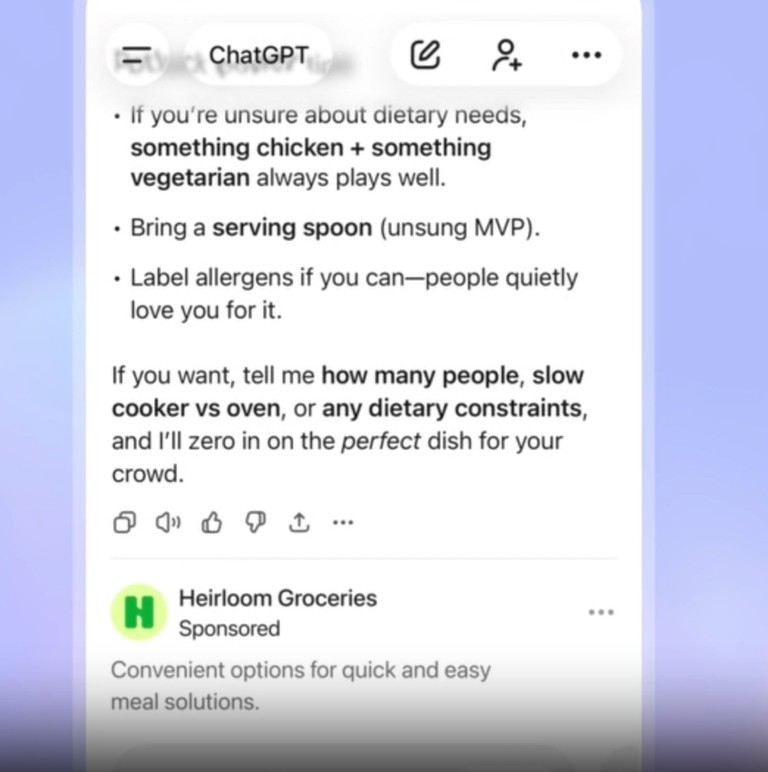
OpenAI has begun rolling out advertisements in ChatGPT for a portion of its U.S. user base. The test targets logged-in users aged 18 and over on the Free and Go plans. Plus, Pro, Business, Enterprise, and Education subscriptions remain ad-free for now.
The change is subtle, but meaningful. Ads appear as clearly labeled sponsored blocks, visually separated from ChatGPT’s responses. On mobile, they can show up in the conversation feed after an answer, similar to a sponsored search result, as early screenshots circulating online already suggest.
🚨 ChatGPT is now showing ads in the U.S.
OpenAI has started testing advertising for Free & Go users.
Paid plans stay ad-free — for now.
Ads don’t affect answers, chats remain private, and users can opt out (with limits).This isn’t about ads.
It’s about what happens when AI… pic.twitter.com/8s0P8HHTLr— Enzvia (@enzvia) February 10, 2026
Why OpenAI Is Introducing Advertising Now
The official explanation is straightforward: infrastructure costs are soaring. Running increasingly powerful models for hundreds of millions of users is difficult to sustain through subscriptions alone.
OpenAI emphasizes several points:
-
ads do not influence ChatGPT’s answers
-
conversations remain private
-
advertisers only receive aggregated performance data, never access to chat logs
Ad targeting relies on broad signals such as the topic of the conversation, prior interactions, and the user’s ad personalization settings.
What Users Can Still Control
At least on paper, OpenAI has put several safeguards in place:
-
no ads shown to users under 18
-
no ads displayed around sensitive topics such as health or politics
-
the ability to hide individual ads, delete ad data, or adjust personalization settings
One important detail: free users can opt out of ads, but doing so comes with a reduced daily message limit. In other words, opting out is possible, but not neutral. Users must trade usage capacity for an ad-free experience.
Why Ads in a Chatbot Are More Controversial Than They Look
Unlike a search engine, a conversational assistant builds continuity and trust over time. The issue isn’t advertising by itself, but the context in which it appears.
Even with a clear visual separation, the psychological boundary is thinner:
-
the user isn’t actively searching for a product
-
the suggestion can feel more personal and context-aware
-
the potential for subtle influence is objectively higher than on a traditional search results page
OpenAI says it intends to keep ads clearly separated from content. Still, the company has already acknowledged plans to introduce additional ad formats over time, without specifying what those will look like.
What This Signals About the Future of ChatGPT
One thing is clear: ChatGPT is no longer an experimental tool. It is a mass-market platform, facing the same economic realities as social networks and search engines.
Advertising marks a strategic turning point. Not a full shift yet, but a clear signal that “free with no trade-offs” is no longer sustainable, even for AI assistants.
The real question isn’t whether ads will become part of chatbots — that’s already happening. The question is how far they will go, and how much compromise users are willing to accept.


