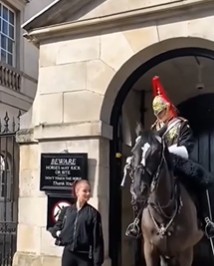
Curious tourists and strict traditions rarely mix well. And some scenes make that painfully clear, loudly.
In this historic setting, everything is regulated down to the smallest detail. Posture. Distance. Movement. Every action follows a precise protocol, rehearsed endlessly, with no room for improvisation. Yet faced with the striking uniform and the almost unreal atmosphere, many visitors forget one simple rule: this is not an interactive show.
One step too far.
One poorly judged gesture.
And the reaction is immediate.
The guard isn’t shouting out of anger. This isn’t a loss of temper or a moment staged for virality. It’ a firm, deliberate reminder of the role he is there to perform. His voice rises because that is exactly what the situation demands. His job is not to explain, and certainly not to negotiate, it is to enforce a clear, non-negotiable boundary.
That contrast is what consistently captivates online audiences. On one side, visitors who assume they’re in a typical tourist attraction. On the other, an institution operating under centuries-old rules that remain rigid and unapologetic. The collision of these two worlds creates the discomfort — and explains why the video spreads so easily.
At its core, the moment delivers a simple message: some places are not meant for testing limits, provoking reactions, or chasing content. They demand something increasingly rare in the age of constant recording, respect, without debate.