Table of Contents
ToggleThe question is flawed, and that’s exactly why it makes people uncomfortable
Asking who was the richest human in history assumes that wealth is objective, stable, and comparable across centuries. It isn’t.
Depending on the era, wealth can mean:
-
personally owned and transferable assets
-
control over production and trade
-
absolute power over land, people, and resources
Each definition produces a different winner. That instability is not a bug. It is the point.
If we define wealth as personal, private, and traceable, the answer is surprisingly modern
This is the strictest definition, and the least forgiving.
Only assets that were personally owned, alienable, and economically documented count. No state treasuries. No empires disguised as balance sheets.
Under this rule, the ranking becomes far less sensational, and far more defensible.
1. John D. Rockefeller
At his peak, Rockefeller controlled roughly 90 percent of US oil refining through Standard Oil.
Adjusted to today’s economy, credible estimates place his fortune between 350 and 450 billion dollars.
Why this holds:
-
privately owned equity
-
sustained monopoly power
-
dividends, not taxation
He did not rule a country. He owned the system supplying its energy.
2. Andrew Carnegie
Carnegie built and sold Carnegie Steel at precisely the right moment.
Adjusted estimates place his wealth near 300 to 350 billion dollars.
Key distinction:
Carnegie exited. Rockefeller consolidated.
That difference alone explains the gap.
3. Jakob Fugger
Often overlooked because he predates modern capitalism, Fugger financed emperors, popes, and wars.
In relative terms, his fortune represented roughly 2 percent of European GDP at its height.
That is an extraordinary concentration of private capital.
What makes him comparable:
-
private ownership
-
financial instruments, not feudal rents
-
political leverage derived from money, not force
4. Cornelius Vanderbilt
Vanderbilt dominated shipping and railroads, the arteries of 19th century America.
Adjusted estimates place him between 200 and 250 billion dollars.
Unlike tech founders today, his advantage came from physical infrastructure that competitors could not replicate cheaply.
5. Jeff Bezos
Bezos deserves inclusion, but also context.
At peak valuation, his net worth approached 200 billion dollars, but:
-
it was almost entirely equity based
-
it fluctuated violently
-
it depended on public markets
By historical standards, his control was narrower and more fragile.
6. Elon Musk
Musk briefly surpassed Bezos on paper.
But his wealth:
-
is heavily leveraged
-
tied to volatile assets
-
partially illiquid
Historically impressive, structurally unstable.
Why figures like Mansa Musa do not belong in this category
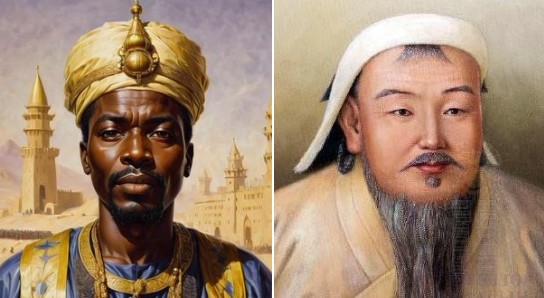
Mansa Musa
Mansa Musa controlled an empire that dominated gold production in the 14th century.
What we do not know:
-
what portion was personally owned
-
what could be sold, inherited, or transferred
-
where state control ended and private wealth began
Calling this “personal wealth” is an anachronism.
It projects modern accounting onto premodern sovereignty.
If wealth is redefined as economic control, the ranking becomes imperial
This is where the numbers explode and the rigor collapses.
Augustus
At his peak, Augustus controlled an empire representing 25 to 30 percent of global GDP.
But this was not personal wealth.
It was:
-
taxation
-
military extraction
-
political authority
Confusing this with private fortune is category error.
If wealth is redefined as total power over resources, the answer becomes disturbing
Genghis Khan
Genghis Khan owned almost nothing personally.
Yet he commanded:
-
vast territories
-
entire populations
-
continental trade routes
If wealth equals the ability to mobilize all available resources, human and material, then he ranks at the top.
Most people reject this definition instinctively.
Not because it is incoherent, but because it is morally uncomfortable.
A ranking that depends on what we are willing to admit
Ranking by real, personal, private wealth
-
John D. Rockefeller
-
Andrew Carnegie
-
Jakob Fugger
-
Cornelius Vanderbilt
-
Jeff Bezos
-
Elon Musk
Ranking by economic control
-
Augustus
-
Mansa Musa
-
Chinese emperors of the Song dynasty
Ranking by total power over resources
-
Genghis Khan
-
Augustus
-
Joseph Stalin
Why the question itself is the problem
Every ranking reveals an ideology.
Modern lists favor capital accumulation.
Ancient lists disguise coercion as prosperity.
Viral lists mix incompatible categories because spectacle travels faster than rigor.
The real issue is not who was richest.
It is which form of wealth we choose to normalize.
That choice says far more about us than about them.