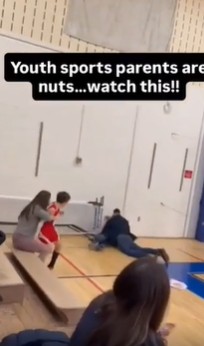
What stands out in this video isn’t just the fight between two kids.
It’s how quickly an adult crosses the line.
The coach does exactly what he’s supposed to do: he steps in, separates the players, and addresses the behavior.
Yet he becomes the target of a parent. As if setting boundaries for a child were a personal attack.
In many youth sports environments, the court or field becomes an extension of parental ego.
Winning stops being a collective learning experience.
It turns into personal validation.
At that point, sport stops being educational.
It becomes a stage for tensions children never asked to carry.
Parental violence isn’t created by sports, it’s revealed by them
Sports don’t invent these behaviors.
They expose them.
Performance pressure.
Unfulfilled ambitions.
The confusion between support and control.
When a parent confronts a coach physically or verbally, it’s not a “moment of passion.”
It’s a warning sign.
Research in sports psychology consistently shows that children exposed to aggressive adult behavior experience higher stress levels, greater dropout rates, and less long-term enjoyment of sport.
This kind of scene doesn’t “build character.”
It damages the relationship with sport itself.
The overlooked role of coaches in youth sports
This video highlights a reality that’s often ignored:
youth coaches are not just instructors.
They are educators, mediators, and often emotional shock absorbers between parents and children.
Attacking a coach means attacking the structure itself.
And without structure, only the loudest voice wins.
The real courage here isn’t confrontation.
It’s the adult who protects the game, even when it comes at a personal cost.