
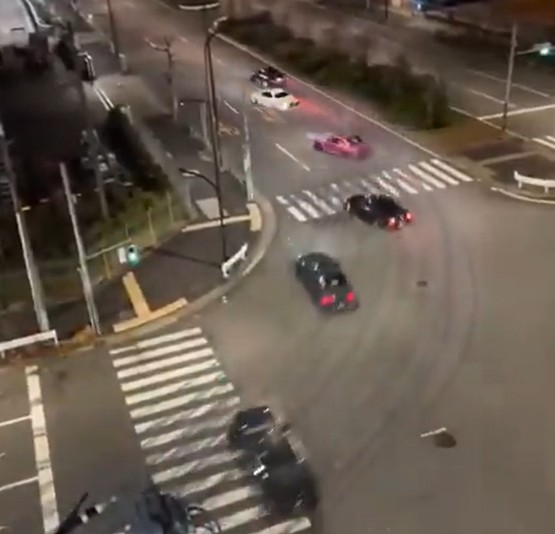
The clip shared on X on January 10 shows several cars charging into a Tokyo intersection at speed, initiating controlled drifts in the middle of the night, ignoring traffic lights, road markings, and any conventional notion of public safety. This is neither a movie scene nor a sanctioned event. It is an illegal use of public roads, filmed from above, likely by a nearby resident.
What makes the video striking is not the stunt itself, but the way it collides with a widely held belief: that Japan is uniformly calm, orderly, and rule-abiding. That image is incomplete. Like any society, Japan has its forms of transgression, they are simply less visible, less talked about, and often pushed into the margins of the night.
Japanese drifting did not begin on social media
Drifting in Japan did not emerge with Twitter or viral videos. Its roots go back to the 1980s and 1990s, at the intersection of mountain roads, amateur circuits, and a highly codified car subculture. Figures such as Keiichi Tsuchiya helped turn a driving technique into a cultural reference point.
But two realities must be separated.
One is regulated drifting, practiced on tracks, legal, structured, and now fully professionalized.
The other is street drifting, illegal, sporadic, and largely about transgression rather than sport.
The viral video clearly belongs to the second category.
Why Tokyo, why at night
Tokyo presents an ideal paradox. It is an ultra-regulated мегacity with high police presence, yet it also has wide road infrastructures that can become almost empty after midnight. Large intersections and peripheral zones occasionally turn into brief stages for risky expression.
Japanese authorities are well aware of this phenomenon. Tokyo Metropolitan Police regularly increase nighttime controls, especially around areas known for car gatherings. Penalties are severe: heavy fines, license suspension, and potential vehicle seizure. Still, some groups persist, partly because the prohibition itself is part of the appeal.
Incivility also exists in highly regulated societies
It is tempting to frame such scenes as “exceptions.” Analytically, that would be a mistake. Highly regulated societies generate their own pressure valves. Incivility does not disappear; it shifts, concentrates, and sometimes becomes ritualized.
In Japan, this transgression often takes spectacular but fleeting forms. Little direct confrontation, little prolonged disorder, but short, intense acts that are openly assumed as such. Street drifting fits squarely within this logic: a brief rupture with order, not a sustained challenge to it.
What this video actually says about Japan
This scene does not suggest that “Japan is becoming uncontrollable.” It points to something far more ordinary and far more interesting: no society is monolithic. Collective discipline and marginal behavior coexist. Apparent calm does not eliminate frustration, risk-taking, or the desire for visibility.
What social media makes visible today already existed yesterday, without cameras and without virality. The difference lies less in the scale of the phenomenon than in its exposure.
Japan remains a country that is broadly safe, structured, and rule-oriented. But believing it to be free of incivility, illegal practices, or transgressive subcultures is closer to fantasy than observation.


