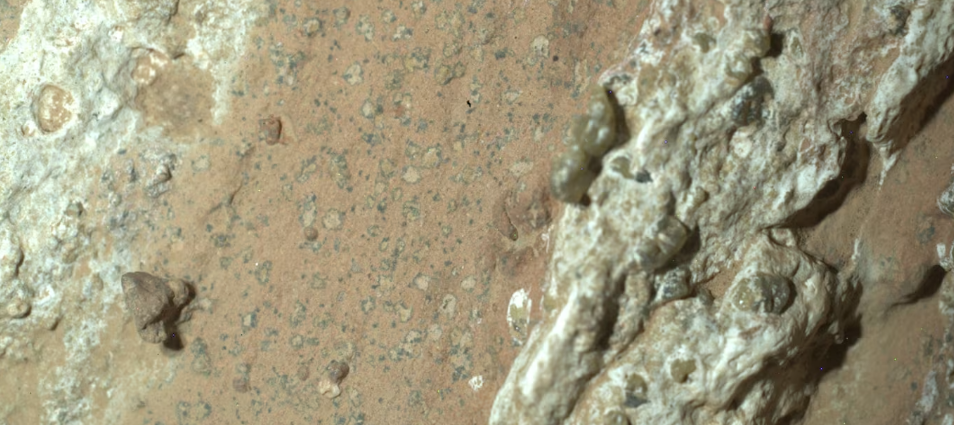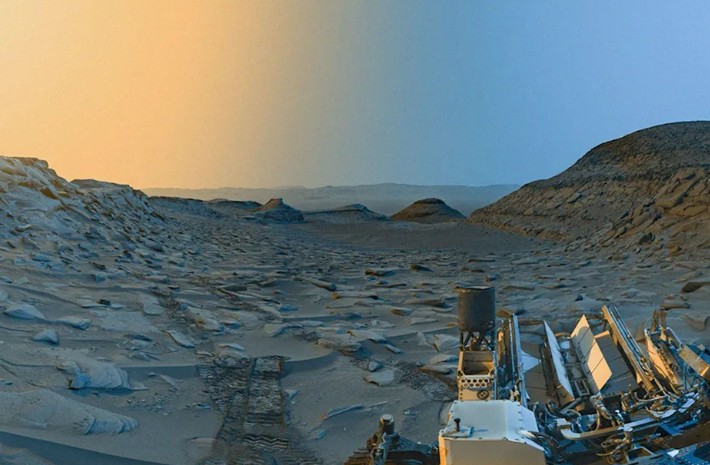
The mars organic molecules discovery has revived a debate NASA has carefully avoided settling for years: what if some of the chemical traces detected on the Red Planet are genuinely linked to ancient biological activity?
In 2025, the rover Curiosity identified long-chain organic molecules — alkanes — in what is believed to be an ancient lake bed inside Gale Crater. These carbon-based compounds could be degraded remnants of fatty acids, fundamental building blocks of cell membranes on Earth.
This is not proof of life.
But it is no longer just a chemical curiosity.
What Exactly Are the Organic Molecules Found on Mars?
The detected molecules are long-chain alkanes. On Earth, such structures are often associated with the breakdown of biological lipids.
A critical distinction must be made:
Organic molecules do not automatically imply life. They can also form through abiotic processes such as:
-
chemical reactions in a primitive atmosphere
-
meteorite impacts
-
hydrothermal activity
The novelty here is not their existence — organic molecules have been found on Mars before — but their concentration and complexity.
According to a study published in the journal Astrobiology, a team led by researchers at the NASA Goddard Space Flight Center argues that the original abundance of these molecules, before millions of years of Martian radiation exposure, must have been significantly higher than previously assumed.
That is where the discussion becomes more serious.
Why Are Non-Biological Explanations No Longer Fully Sufficient?
Mars lost most of its atmosphere roughly four billion years ago. Since then, its surface has been exposed to intense cosmic radiation.
Researchers modeled the effects of 80 million years of radiation on these molecules. The conclusion: for detectable traces to remain today, their initial concentration would have needed to be far greater.
Here lies the difficulty.
Even when combining multiple known abiotic mechanisms — meteoritic delivery, ancient atmospheric chemistry, geological reactions — the models fail to reproduce concentrations consistent with current observations.
The authors explicitly state that such levels are “difficult to explain solely through known non-biological processes.”
This is not a declaration of life detection.
It is a declaration that current abiotic models may be incomplete.
The distinction matters.
Was Mars Truly Habitable?
Data gathered by Curiosity suggests that billions of years ago, Mars had:
-
persistent lakes
-
flowing rivers
-
a denser atmosphere
-
chemical conditions compatible with microbial life
On Earth, comparable environments gave rise to microbial life relatively quickly.
The scientific question has gradually shifted.
It is no longer simply:
“Was Mars habitable?”
It is increasingly:
“Was Mars actually inhabited?”
The mars organic molecules discovery adds to a growing list of converging clues: past liquid water, clay minerals, favorable geochemistry, and now complex organic compounds that persisted despite prolonged radiation exposure.
Why Is NASA Still Exercising Extreme Caution?
Astrobiology has a history of premature excitement. Each overstated claim has reinforced institutional caution.
The researchers themselves echo a principle often associated with Carl Sagan: extraordinary claims require extraordinary evidence.
To confidently declare life beyond Earth, scientists would need:
-
multiple independent lines of evidence
-
consistent isotopic signatures
-
molecular structures that resist abiotic explanation
-
ideally, confirmation from returned samples analyzed on Earth
At this stage, the mars organic molecules discovery is an intriguing signal — not a verdict.
What This Discovery Actually Changes
It subtly shifts the center of gravity in the debate.
For years, the question was:
“Can we rule out a biological origin?”
Now, the framing is evolving toward:
“Are known abiotic processes truly sufficient to explain what we are observing?”
That shift is subtle but meaningful.
It does not prove that ancient life existed on Mars.
It suggests that non-biological explanations must be strengthened, expanded, or revised.
And scientific turning points often begin in precisely this kind of uncertainty.
The next decisive step will likely depend on future Mars sample return missions. If these molecules reveal distinctive isotopic patterns or structural characteristics strongly associated with biological processes, the discussion will change dramatically.
For now, one conclusion is defensible:
Mars has not finished telling its story.