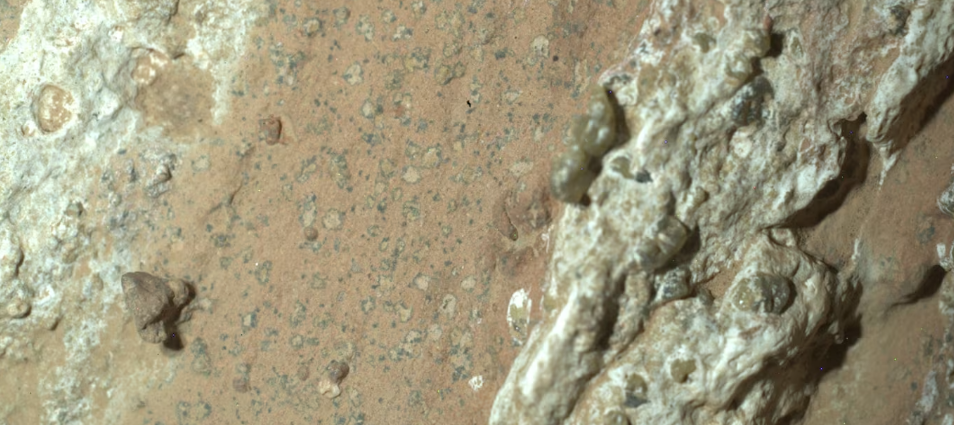
For generations, the possibility of life on Mars lived in the pages of novels and the frames of Hollywood movies. That all changed when NASA officially announced that its Perseverance rover had uncovered fossilized microbial patterns in the Sapphire Falls rock sample. According to NASA’s Mars Science Laboratory team, the signatures discovered are far more than a curiosity: they represent the strongest evidence yet that Mars once hosted living organisms.
What the Sapphire Falls Sample Revealed
The Perseverance rover drilled into the Sapphire Falls formation, an area shaped by an ancient river delta in Jezero Crater. Early analysis revealed a remarkable combination of organic molecules, mineral layering, and microscopic structures. Together, these findings point toward biological activity rather than purely geological processes.
NASA researchers used spectroscopic imaging and X-ray diffraction to confirm the presence of organics that could not be explained by volcanic or chemical reactions alone. “These textures and patterns are best interpreted as traces of microbial life,” explained Dr. Ken Farley, Perseverance’s project scientist.
Why This Discovery Matters
This announcement is more than a milestone for planetary science. It challenges humanity’s understanding of life itself. If Mars, a world once thought barren and hostile, supported microbial ecosystems, then the universe may be teeming with life.
Dr. Lori Glaze, director of NASA’s Planetary Science Division, summarized the breakthrough with striking clarity: “We are no longer speculating about Mars’ habitability. We are seeing evidence of ancient life preserved in its rocks.”
The Next Step: Mars Sample Return
The discovery will shape the future of NASA’s Mars Sample Return mission, designed to bring pieces of the Martian surface back to Earth for in-depth analysis. These samples could confirm whether the microbial structures are truly biological, opening the door to questions about evolution, survival, and interplanetary biology.
The mission, planned for the early 2030s, is now viewed as one of the most important undertakings in space exploration. Protecting these samples will also demand strict planetary protection protocols to avoid cross-contamination between Earth and Mars.
A New Era for Space Exploration
NASA’s announcement will inevitably influence international space policy, future missions, and even philosophical debates. Space agencies around the world, from ESA to private companies like SpaceX, are rethinking what crewed missions to Mars could look like when life, even ancient, is at stake.
Beyond science, the discovery stirs cultural and existential questions. Are humans prepared to recognize life beyond Earth? Could similar evidence exist on other icy moons, such as Europa or Enceladus, where subsurface oceans may harbor living systems?
Humanity’s Perspective Changes Forever
What was once a dream of astronomers and sci-fi authors is now reality: Mars was not always a dead world. Evidence of ancient microbes confirms that life is not unique to Earth. For many, this transforms the way we think about our place in the cosmos.
As one NASA spokesperson put it: “We are witnessing history. Mars is no longer just a red planet, it is a once-living world and perhaps not the last.”
Frequently Asked Questions About NASA’s Mars Discovery
Did NASA really find life on Mars?
Yes. NASA confirmed that the Perseverance rover detected fossilized microbial patterns in the Sapphire Falls rock sample. While these microbes are ancient and not living today, they provide the clearest evidence so far that Mars once supported life.
What is the Sapphire Falls rock sample?
Sapphire Falls is a rock formation inside Jezero Crater, believed to be part of an ancient river delta. The Perseverance rover drilled into this formation and discovered preserved organic molecules and textures consistent with microbial life.
How do scientists know it is biological and not geological?
Researchers used advanced techniques such as spectroscopic analysis and X-ray diffraction. The structures found are not consistent with known geological processes, making biological activity the most likely explanation.
Does this mean there could still be life on Mars today?
The discovery points to ancient life, not modern organisms. However, it proves Mars was once habitable, which increases the chances that microbial life could survive underground or in protected environments today.
Why is this discovery important?
It is the first direct evidence that life is not unique to Earth. This reshapes humanity’s understanding of biology, evolution, and the likelihood of life elsewhere in the universe.
What is next after this discovery?
NASA is preparing the Mars Sample Return mission to bring these rocks back to Earth. Detailed laboratory studies could confirm the microbial nature of the samples and open new areas of research in astrobiology.
Will astronauts still go to Mars after this discovery?
Yes, but with greater caution. The presence of past life means stricter planetary protection protocols will be required to prevent contamination both ways, protecting Mars from Earth organisms and Earth from Martian material.
Could similar discoveries happen on other planets or moons?
Definitely. Moons like Europa (Jupiter) and Enceladus (Saturn) contain subsurface oceans that may harbor life. The discovery on Mars strengthens the argument for exploring these worlds.