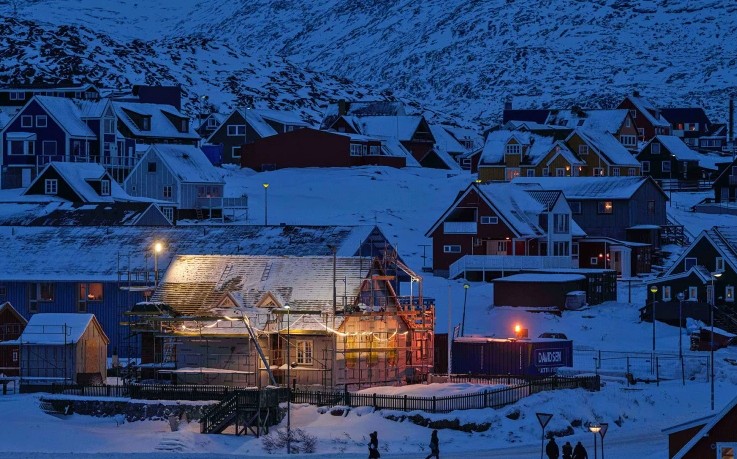
Greenland, an autonomous territory within the Kingdom of Denmark, was until recently a discreet dot on NATO’s strategic map. That is no longer the case. According to CNBC, troops from several NATO member states, including Denmark and Germany, are now deployed or rotating through the Arctic island.
Officially, these deployments are framed as exercises, defensive cooperation, and deterrence. Unofficially, they reflect growing concern over the rapid transformation of the Arctic into a credible zone of military competition.
Greenland occupies a singular geographic position: halfway between North America, Europe, and the Arctic Ocean. It already hosts critical infrastructure, most notably the U.S. Thule Air Base, which is integrated into America’s missile defense architecture. Strengthening a European military presence nearby effectively secures a key link in NATO’s northern flank.
This reinforcement comes amid Russia’s expanding military footprint in the Arctic, including the modernization of former Soviet bases and an increase in naval patrols. China, for its part, now describes itself as a “near-Arctic state” and continues to invest in polar shipping routes.
NATO is not opening a new front. It is acknowledging a strategic reality: the Arctic is no longer politically frozen.
The Strategic Stakes Surrounding Greenland
Why Greenland Concentrates So Many Interests
The first stake is geographic. Greenland controls access to critical air and maritime routes between Europe and North America. As ice melt accelerates, Arctic shipping lanes are becoming increasingly viable, shortening commercial routes between Asia and Western markets.
The second stake is economic. Greenland’s subsoil contains rare earth elements, uranium, and other strategic resources essential to defense industries and energy transition technologies. For now, extraction remains limited, but the potential alone is enough to attract major powers.
The third stake is military. Control of the Arctic offers strategic advantages for tracking and intercepting intercontinental ballistic missile trajectories. In modern military doctrine, the far north is no longer a periphery but a strategic shortcut.
The Often Overlooked Local Political Factor
One frequently underestimated dimension is the position of Greenland’s own population. The territory enjoys broad autonomy and hosts an ongoing debate over independence from Denmark. Any increase in military presence risks reigniting local tensions, especially if perceived as imposed from the outside.
At this stage, no popular consultation has accompanied the intensified military posture, which represents a genuine political constraint over the long term.
Trump, NATO, and the Normalization of Once-Marginal Ideas
When Donald Trump floated the idea of purchasing Greenland in 2019, it was widely met with ridicule and disbelief. In 2026, the context has shifted. No one is talking about buying the island, but everyone is discussing control, presence, and influence.
This shift is revealing. Certain geopolitical intuitions, even when poorly expressed, can precede real strategic realignments. That does not make them correct, but it does make them no longer anecdotal.
A Fragile Stability
It would be inaccurate to describe Greenland as heavily militarized. Troop levels remain limited, and NATO continues to emphasize a defensive posture. Still, the political signal is unambiguous: the Arctic has now entered the core strategic calculations of major powers.
The region’s stability will depend less on climate conditions than on the ability of those powers to avoid escalation through cumulative presence. On that point, there is currently no clear indication that such a threshold has been defined.